Introduction
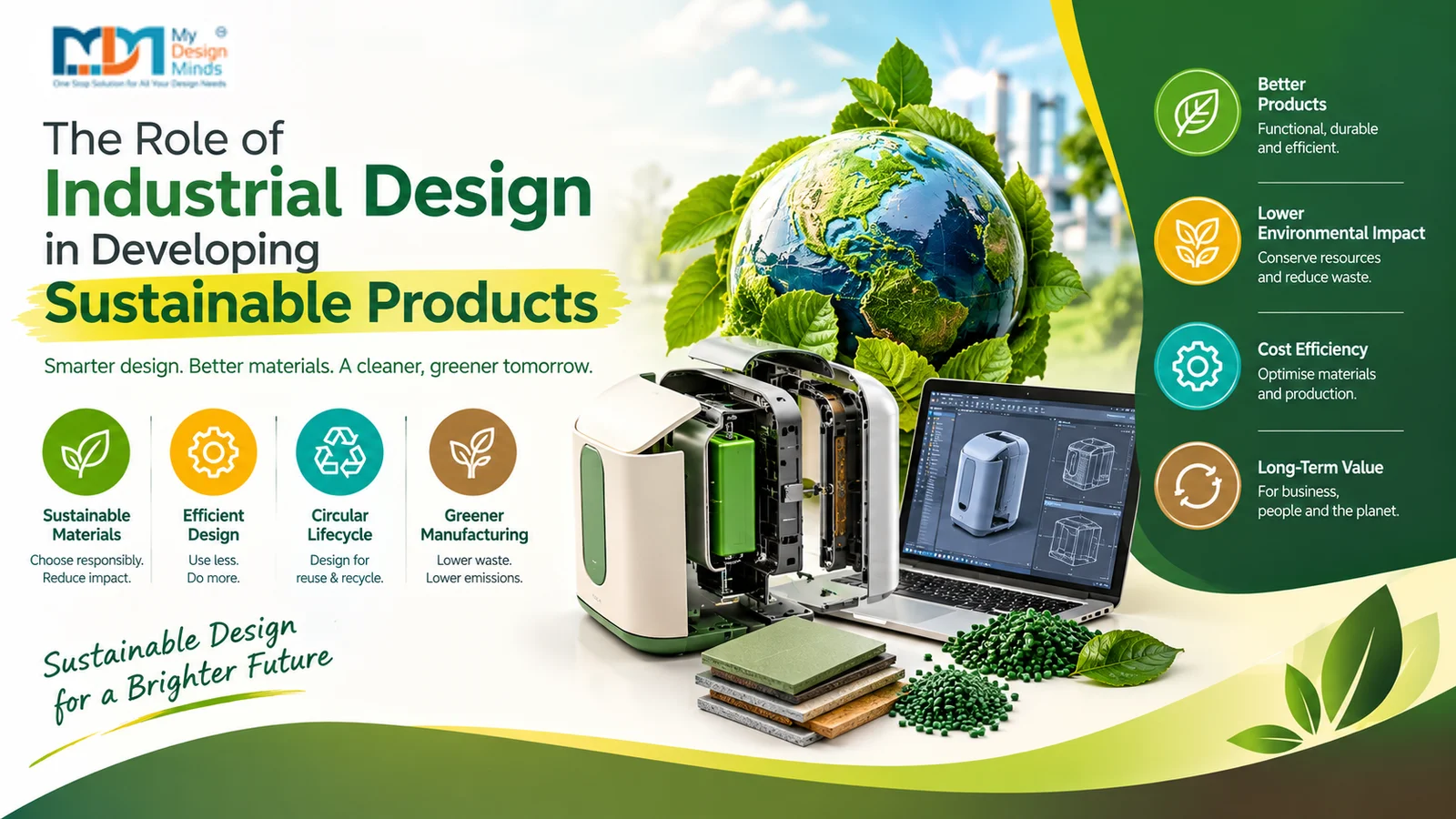
Sustainability is becoming an important consideration in modern product development. Businesses are increasingly looking for ways to reduce material waste, improve product durability, lower energy consumption, and create products that have a smaller environmental impact. Industrial design plays an important role in achieving these objectives because many sustainability decisions are made during the early stages of product development.
Sustainable Industrial Design focuses on creating products that balance functionality, appearance, manufacturability, cost, and environmental considerations. By considering sustainability from the beginning, designers can help businesses develop products that use resources more efficiently throughout their lifecycle.
Selecting Materials More Responsibly
Material selection has a major influence on a product’s environmental impact. Industrial designers can evaluate different materials based on durability, availability, recyclability, weight, manufacturing requirements, and expected product life.
Choosing a material simply because it is inexpensive may create additional environmental and operational costs later. Instead, designers can consider whether a material can withstand the intended application and whether it can be reused or recycled after the product reaches the end of its useful life.
This approach makes Sustainable Product Design an important part of responsible product development.
Designing for Longer Product Life
A durable product generally does not need to be replaced as frequently as a short-lived product. Industrial design can therefore contribute to sustainability by improving product durability, reliability, repairability, and maintainability.
Designers can consider factors such as component strength, wear, environmental exposure, accessibility, and ease of maintenance. Products designed with replaceable components may also remain useful for longer because individual parts can be repaired or replaced instead of discarding the complete product.
Longer product life can reduce material consumption while also providing value to customers.
Reducing Material Waste
Efficient use of materials is another important consideration. Industrial designers can optimise product geometry and component dimensions to reduce unnecessary material without compromising performance.
Digital CAD modelling makes it easier to evaluate different configurations before physical production. Designers can identify areas where material can potentially be reduced and develop components that are both functional and efficient.
These decisions can support Eco-Friendly Product Development by reducing unnecessary material usage during manufacturing.
Improving Manufacturing Efficiency
Sustainability is not limited to the finished product. The manufacturing process itself can influence energy use, waste generation, transportation requirements, and overall resource consumption.
Industrial designers can work with engineers and manufacturers to develop products that are easier to manufacture and assemble. Simplifying components, reducing unnecessary parts, and selecting suitable manufacturing processes can help streamline production.
A well-planned design can also reduce manufacturing defects and rework, preventing additional material and energy consumption.
Designing for Repair and Reuse
Products that are difficult to repair may be discarded even when only one component has failed. Industrial design can address this problem by considering accessibility and component replacement during development.
Designers can create products where important components can be accessed without destroying the product. Standardised fasteners, modular components, and replaceable parts can make maintenance easier.
This approach supports circular product thinking by keeping products and materials in use for longer periods.
Considering Product Lifecycle
A sustainable product should be evaluated beyond its initial manufacturing stage. Designers can consider the complete lifecycle, including raw material selection, production, transportation, usage, maintenance, and end-of-life disposal.
Lifecycle thinking can reveal opportunities to reduce environmental impact at different stages. For example, a lightweight design may reduce material consumption and transportation requirements, while an energy-efficient product can reduce resource use during operation.
Green Product Development therefore requires designers to consider the product as a complete system rather than focusing only on its appearance.
Supporting Innovation Through Digital Tools
Modern digital design technologies can help designers test and refine sustainable concepts before production. 3D CAD models, digital prototypes, simulations, and visualisation tools allow teams to evaluate different design options without immediately producing multiple physical samples.
These tools can support faster design iterations and better communication between designers, engineers, manufacturers, and clients.
Digital development also makes it easier to document product information and maintain accurate design data for future modifications or product improvements.
Balancing Sustainability and Business Requirements
Sustainable product development must also consider commercial requirements. A product needs to be practical, reliable, manufacturable, and economically viable.
Industrial designers can help businesses identify where sustainability improvements provide meaningful benefits without unnecessarily increasing complexity or cost. The objective is to find a balanced solution that meets customer expectations while improving resource efficiency.
For startups and SMEs, this approach can be particularly useful because thoughtful design decisions made early can prevent expensive changes later.
The Future of Sustainable Industrial Design
As manufacturers and consumers become more conscious of resource efficiency, durability, and responsible production, sustainability is likely to become increasingly integrated into industrial design practices.
Businesses that consider environmental factors early in product development can explore opportunities to improve material efficiency, product longevity, repairability, and manufacturing processes.
Sustainable Industrial Design is therefore not simply about making products environmentally friendly. It is about creating better-designed products that use resources thoughtfully, perform effectively, and provide value throughout their lifecycle.
My Design Minds
My Design Minds supports businesses with integrated product design, engineering, prototyping, and manufacturing solutions. Our team applies Sustainable Industrial Design principles while developing practical and production-ready products. We consider material selection, product durability, manufacturability, component optimisation, and lifecycle requirements during development. Our Sustainable Product Design approach helps businesses explore efficient product concepts while maintaining functionality and quality. Through Eco-Friendly Product Development, we support CAD modelling, product engineering, prototyping, and design improvements. Our expertise in Green Product Development helps clients consider resource efficiency and manufacturing requirements from the early design stage. By combining digital design tools with engineering knowledge, My Design Minds helps startups, SMEs, and manufacturers develop products that are functional, durable, efficient, and better prepared for responsible