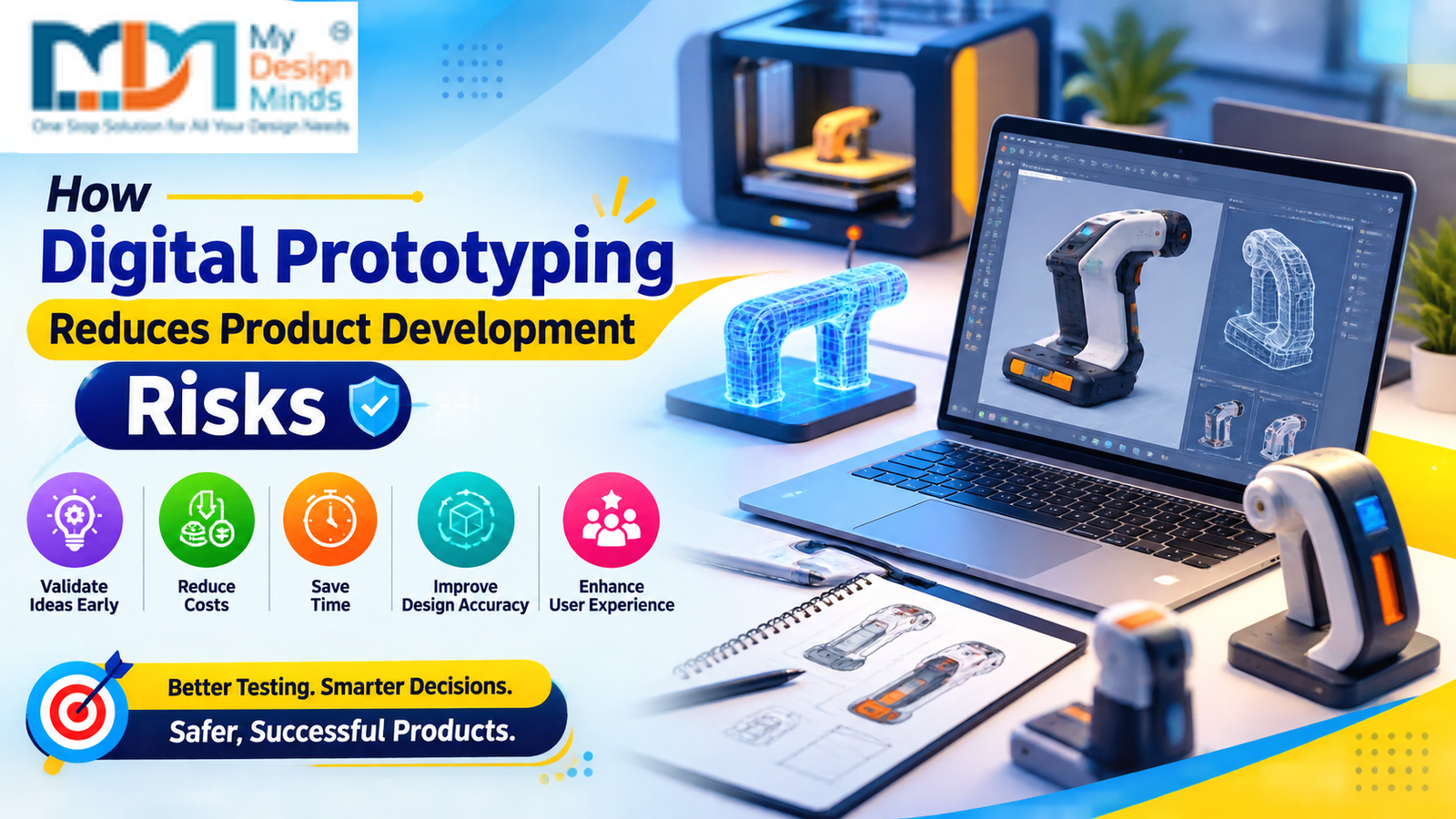
Product development involves multiple stages, from concept creation and design to engineering, testing, manufacturing, and market launch. Mistakes at any stage can lead to increased costs, delays, redesigns, or product failures. Digital Prototyping Services provide businesses with a practical way to evaluate product concepts and identify potential problems before investing heavily in physical prototypes or manufacturing.
1. Identifying Design Problems Early
One of the biggest benefits of digital prototyping is early problem detection. Engineers can create detailed virtual representations of a product and evaluate its dimensions, components, assemblies, and functionality.
Potential problems such as incorrect proportions, component interference, insufficient clearance, or difficult assembly can be identified before physical production begins. Making changes digitally is generally easier than modifying a physical prototype or production tooling.
This early-stage evaluation helps businesses reduce uncertainty and make better design decisions.
2. Reducing Physical Prototype Costs
Traditional prototyping can require materials, machining, tooling, labor, and assembly. When multiple design iterations are necessary, these costs can quickly increase.
3D Product Prototyping allows engineers to evaluate different concepts digitally before creating physical models. Designers can compare alternative configurations, test dimensions, and make modifications within a digital environment.
Once the design reaches a suitable level of maturity, a physical prototype can be created with greater confidence. This can reduce unnecessary prototype iterations and associated development expenses.
3. Improving Product Visualization
Understanding a product from conventional drawings can sometimes be difficult, particularly when the product contains complex assemblies or sophisticated mechanisms.
Digital prototypes provide a three-dimensional view of the proposed product. Designers, engineers, manufacturers, and clients can examine the product from different perspectives and understand how individual components relate to one another.
Realistic digital models can also improve communication with non-technical stakeholders, making design reviews more productive.
4. Supporting Virtual Product Development
Virtual Product Development enables teams to evaluate product concepts without immediately committing to physical manufacturing. Digital models can be reviewed, modified, and shared among geographically distributed teams.
This approach is particularly useful when designers, engineers, clients, and manufacturing partners work from different locations.
Teams can review the same digital model, provide feedback, and make coordinated changes. This improves collaboration and helps reduce communication gaps during development.
5. Testing Different Design Options
Product development rarely follows a single straight path. Engineers may need to compare several materials, component configurations, dimensions, or mechanisms before selecting the final solution.
Digital prototyping makes this comparison easier. Teams can create multiple design variations and assess their advantages and limitations.
For example, a manufacturer developing an equipment enclosure could evaluate different wall thicknesses, mounting arrangements, access panels, and ventilation configurations digitally before selecting the most practical design.
6. Improving Product Design Validation
Product Design Validation is essential for determining whether a proposed design meets its intended requirements. Digital prototypes provide a valuable foundation for this process.
Engineers can review component relationships, dimensions, assembly sequences, accessibility, and potential functional concerns before physical testing.
When combined with simulation and engineering analysis, digital models can provide additional insights into how a design may respond to loads, movement, heat, or other operating conditions.
7. Supporting Better Manufacturing Decisions
A product should not only function correctly; it should also be practical to manufacture. Digital prototyping allows designers to consider manufacturing requirements before production begins.
Teams can review part geometry, assembly methods, material choices, tolerances, and production processes. Potential manufacturing difficulties can then be addressed while the design is still flexible.
This approach can reduce the possibility of discovering manufacturing problems after tooling or production equipment has already been prepared.
8. Improving Collaboration Between Departments
Product development usually involves several departments. Engineering teams focus on functionality, designers consider appearance and usability, while manufacturing teams concentrate on production feasibility.
A digital prototype provides a common reference for these teams.
With Digital Prototyping Services, stakeholders can review the same product representation and discuss specific design areas. This makes technical communication clearer and can reduce misunderstandings that might otherwise result in costly revisions.
9. Accelerating Product Development
Time-to-market is important for businesses competing in rapidly changing markets. Delays caused by repeated physical prototyping, design errors, or manufacturing problems can reduce commercial opportunities.
Digital prototyping can shorten the iteration cycle because design modifications can be made quickly. Engineers can evaluate changes and share updated models without waiting for every revision to be physically manufactured.
This allows development teams to progress through design iterations more efficiently.
10. Creating More Reliable Products
Risk reduction ultimately contributes to product reliability. When businesses identify design weaknesses, manufacturing constraints, and functional concerns before production, they have more opportunities to improve the final product.
3D Product Prototyping combined with Product Design Validation can help businesses develop products that better meet technical and customer requirements.
The goal is not simply to create a visually accurate digital model. The goal is to use digital development as a decision-making tool that improves the entire product development process.
Digital Prototyping as a Strategic Advantage
Digital Prototyping Services can help companies move from concept to production with greater confidence. By identifying issues early, reducing unnecessary physical prototypes, improving collaboration, and supporting manufacturing decisions, digital prototyping can significantly reduce development uncertainty.
For entrepreneurs and startups, this approach can be especially valuable when resources are limited. Before investing heavily in tooling, inventory, or manufacturing infrastructure, businesses can digitally evaluate their product concepts and identify areas that require improvement.
My Design Minds: Your Product Development Partner
My Design Minds provides professional design and engineering solutions to help businesses transform ideas into practical products. Our capabilities include CAD design, product engineering, reverse engineering, 3D visualization, prototyping, and manufacturing support. We help clients develop accurate digital models, evaluate concepts, refine designs, and prepare products for production. Our team focuses on practical engineering, clear communication, and manufacturability throughout the development process. Whether you are a startup developing your first product or an established manufacturer improving an existing solution, My Design Minds provides flexible support across the product development journey. We aim to help businesses reduce design risks, improve product quality, control development costs, and move confidently from concept to prototype and manufacturing.