Introduction
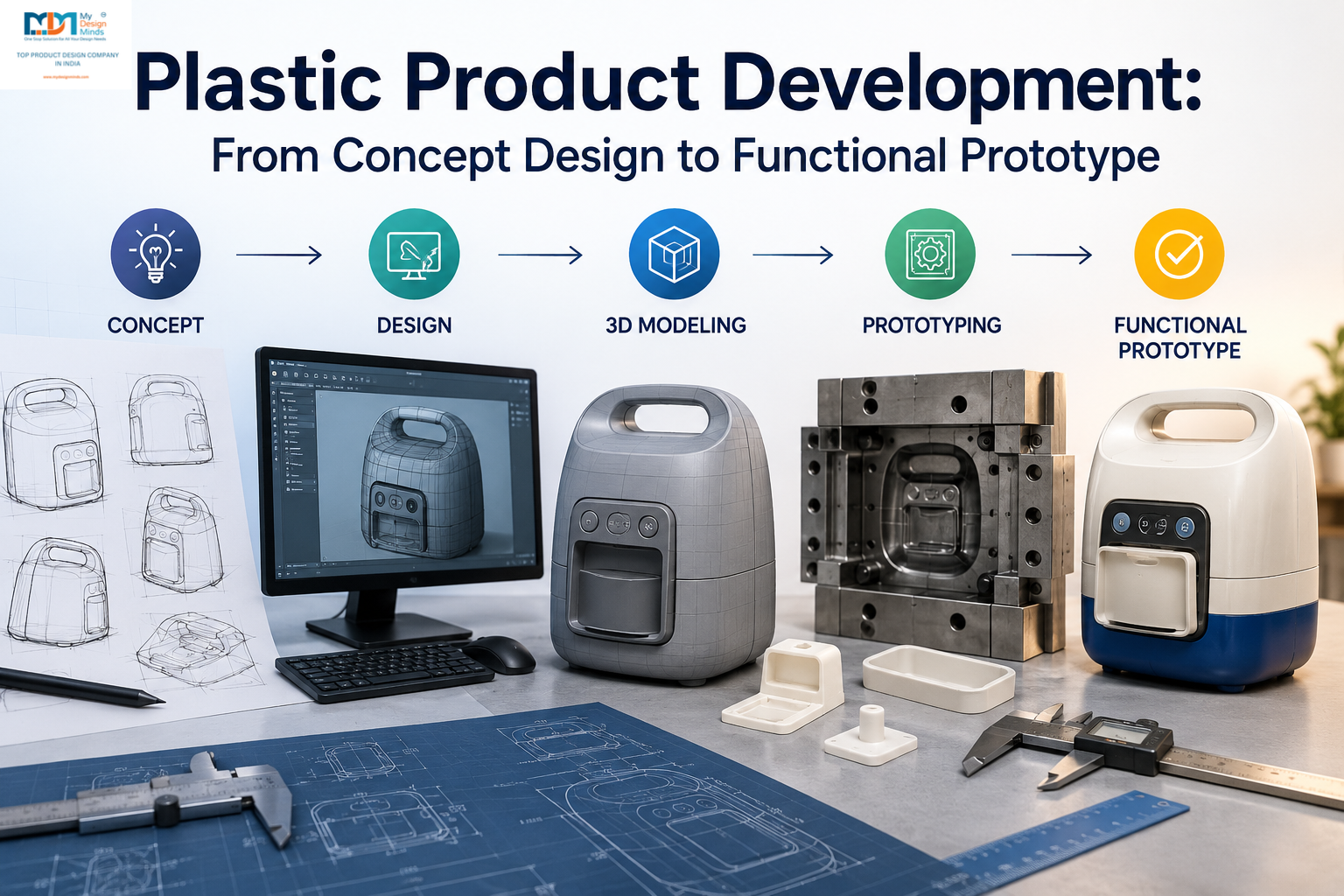
Plastic Product Development involves much more than creating an attractive shape. Manufacturers must consider functionality, ergonomics, materials, manufacturability, durability, assembly, and production costs before moving into mass production. A structured product development process helps transform an initial idea into a reliable and functional prototype.
From concept sketches and digital modeling to prototype testing and design refinement, each stage plays an important role in creating a successful plastic product. Modern tools such as CAD modeling and 3D Product Visualization Services allow designers and manufacturers to evaluate ideas digitally before investing in molds, tooling, and large-scale production.
1. Start With Concept Development
The first stage of plastic product development is turning an idea into a clear product concept. Designers study the intended application, target users, product dimensions, operating environment, and required functions.
Initial concepts may begin as sketches, reference images, or basic digital models. The objective is to define the product’s overall form and establish the key features that will influence later engineering decisions.
At this stage, designers also consider usability and ergonomics. A product should be comfortable to hold, operate, transport, clean, or maintain depending on its application.
2. Create Detailed 3D CAD Models
Once the concept is established, designers develop a detailed three-dimensional model. Plastic Product Design Services help convert design ideas into accurate CAD models that include dimensions, surfaces, components, interfaces, and assembly features.
CAD modeling allows designers to examine the product from different angles and make changes without physically modifying a prototype. It also provides a foundation for engineering drawings, simulations, rendering, prototyping, and manufacturing preparation.
A well-developed model can help teams identify potential problems with proportions, clearances, wall thickness, component placement, and assembly requirements before production.
3. Visualize the Product Before Manufacturing
Visual communication is particularly useful when several stakeholders are involved in a product development project. 3D Product Visualization Services can create realistic representations showing colors, materials, textures, finishes, and product details.
These visuals make it easier for clients, engineers, designers, and marketing teams to understand how the finished product may appear. Different design options can also be presented side by side, allowing stakeholders to compare concepts and provide feedback.
Early visualization can reduce misunderstandings and support faster design approval before the project moves further into development.
4. Select the Right Plastic Material
Material selection has a major impact on product performance. Different plastic materials offer different levels of strength, flexibility, heat resistance, chemical resistance, weight, durability, and surface quality.
The right material depends on the product’s intended environment and functional requirements. Designers may consider materials such as ABS, polypropylene, polycarbonate, nylon, or other engineering plastics based on the application.
Material selection should also consider the intended manufacturing process. A material that performs well in one application may not be suitable for another because of processing requirements, shrinkage, strength, or finishing needs.
5. Design for Manufacturing
A visually attractive design must also be practical to manufacture. Designers consider factors such as draft angles, uniform wall thickness, ribs, bosses, parting lines, snap-fits, and assembly requirements.
These details are important for injection molding and other plastic manufacturing processes. Proper design can help reduce defects, simplify tooling, improve consistency, and control production costs.
3D CAD Modeling Services support this stage by allowing engineers to modify geometry and evaluate manufacturing requirements before physical tooling is created.
6. Develop a Functional Prototype
After the digital design has been refined, the next step is prototype development. Plastic Prototype Development helps teams create physical versions of the product for evaluation.
Depending on the project, prototypes may be produced using 3D printing, CNC machining, vacuum casting, or other suitable processes. A prototype provides an opportunity to evaluate the product’s size, appearance, ergonomics, assembly, and basic functionality.
Physical testing can uncover issues that may not be obvious in digital models. These findings can then be used to improve the design before final tooling and production.
7. Test and Refine the Design
Product development is an iterative process. After testing the prototype, teams review the results and identify areas that require improvement.
Changes may involve dimensions, material selection, grip, component placement, wall thickness, mechanical interfaces, or assembly methods. Updated CAD models can then be created and new prototypes produced when necessary.
This iterative approach helps manufacturers improve product reliability while reducing the risk of expensive modifications after production begins.
8. Prepare for Production
Once the prototype meets the required design and functional expectations, the product can move toward manufacturing. Detailed documentation, final CAD data, engineering drawings, tooling requirements, and production specifications are prepared.
For injection-molded products, this may include mold design and tooling development. Production planning can also consider assembly, finishing, packaging, quality inspection, and scalability.
A well-managed transition from concept to production helps ensure that the final product maintains its intended appearance and performance while remaining practical to manufacture.
Conclusion
Plastic product development requires a combination of creative design, engineering knowledge, digital modeling, material selection, prototyping, and testing. From the first concept to the final functional prototype, each stage contributes to product quality and manufacturability.
Using 3D Product Visualization Services alongside CAD modeling and prototyping can help businesses communicate ideas, evaluate designs, identify potential issues, and make more informed development decisions. A structured workflow can ultimately reduce unnecessary iterations and create a stronger foundation for successful production.
How My Design Minds Supports Plastic Product Development
My Design Minds helps businesses transform plastic product ideas into practical, production-ready solutions. Its team supports Plastic Product Design Services, CAD modeling, product visualization, prototype development, and manufacturing-focused design. From early concept development to detailed digital models and functional prototypes, My Design Minds focuses on accuracy, usability, and manufacturability. The team can help evaluate product forms, select suitable design approaches, refine components, and prepare models for prototyping and production. By combining design expertise with modern digital tools, My Design Minds helps businesses reduce development challenges, improve product concepts, and move confidently from an initial idea toward a functional and commercially viable plastic product.