Introduction
Modern product development requires accuracy, speed, and flexibility. When companies need to recreate an existing component, improve an outdated product, or develop a replacement part, traditional measurement methods can be time-consuming and may not capture complex geometries accurately. This is where 3D scanning technology provides an effective solution.
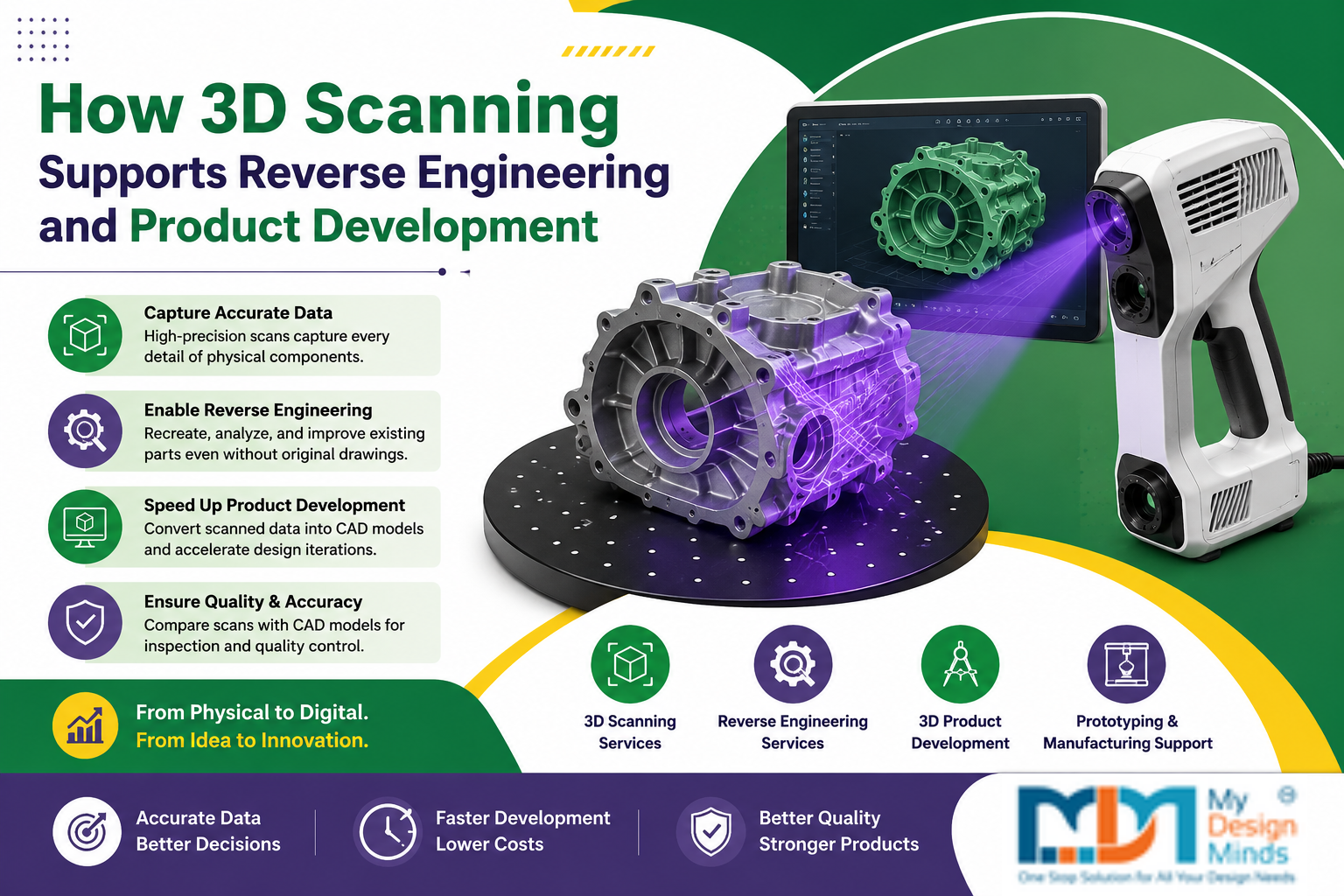
3D Scanning Services use specialized scanners to capture the physical shape and dimensions of an object and convert them into a detailed digital model. The resulting data can be used for reverse engineering, CAD modeling, inspection, prototyping, product redesign, and manufacturing.
From automotive components and industrial machinery to consumer products and customized parts, 3D scanning helps businesses transform physical products into usable digital data.
What Is 3D Scanning?
3D scanning is a process that captures the surface geometry of a physical object using technologies such as structured light, laser scanning, or other optical scanning methods. The scanner collects thousands or millions of data points to create a digital representation known as a point cloud.
The point cloud can then be processed and converted into a polygon mesh or used as a reference for creating a CAD model. This makes it possible for engineers and designers to work digitally with products that may not have original drawings or CAD files.
1. Supports Accurate Reverse Engineering
One of the most important applications of 3D scanning is reverse engineering. When original drawings, specifications, or CAD files are unavailable, engineers can scan an existing component and capture its geometry.
The collected information provides a foundation for creating accurate digital models. Reverse Engineering Services can use this data to understand dimensions, shapes, interfaces, and design features before developing a new or improved component.
This is particularly useful for replacement parts, legacy equipment, discontinued products, and components that need design modifications.
2. Helps Recreate Complex Geometries
Traditional measuring tools may struggle with curved surfaces, free-form shapes, intricate details, and irregular geometries. 3D scanning can capture these features more efficiently.
The digital scan provides detailed geometric information that designers can use during CAD modeling. This allows complex products to be recreated without manually measuring every surface.
For industries working with customized components, molds, machinery, automotive parts, and consumer products, this capability can significantly simplify the development process.
3. Accelerates Product Development
Product development often involves several stages, including concept creation, CAD modeling, prototyping, testing, and manufacturing. 3D scanning can help shorten the transition between the physical and digital stages.
For example, an existing product can be scanned, converted into usable digital data, modified in CAD software, and prepared for prototyping. This approach helps teams identify design opportunities faster and make informed improvements.
3D Product Development also benefits when companies need to modify an existing product rather than develop an entirely new design from the beginning.
4. Improves CAD Modeling
Accurate digital references are essential for creating reliable CAD models. Scanning data can provide designers with detailed information about the original product’s geometry.
Engineers can use the scan as a reference while rebuilding surfaces, dimensions, mounting points, and other critical features. This can reduce the possibility of errors caused by manual measurements.
The resulting CAD model can then be used for design modifications, simulations, documentation, prototyping, and manufacturing.
5. Helps Improve Existing Products
Businesses often need to upgrade products because of changing customer requirements, performance issues, manufacturing limitations, or outdated components.
Scanning an existing product creates a digital baseline that designers can analyze before making changes. They can identify areas that need improvement and develop updated designs while retaining important functional characteristics.
This approach can be valuable when redesigning housings, brackets, tools, machine components, enclosures, and other products.
6. Supports Quality Inspection
3D scanning is also useful for comparing manufactured parts against their intended geometry. A scanned component can be compared with its CAD model to identify dimensional variations and deviations.
Color maps and digital inspection reports can help engineers understand where a component differs from the reference model. This supports quality control and helps manufacturers identify production problems.
3D Scanning Technology can therefore contribute not only to product development but also to inspection and quality assurance.
7. Enables Faster Prototyping
Once physical geometry has been converted into digital data, the model can be modified and prepared for prototyping. Depending on the application, the digital model can be used for 3D printing, CNC machining, or other manufacturing methods.
This creates a practical connection between scanning, CAD development, and physical prototyping. Designers can make changes digitally and produce revised prototypes without repeatedly starting the measurement process from scratch.
8. Reduces Development Time and Cost
Manual measurement, repeated physical trials, and recreating complex components from limited information can increase development time and costs. 3D scanning services provides a faster method for collecting detailed geometry.
By creating accurate digital references earlier in the workflow, companies can reduce unnecessary iterations and make better design decisions. Reverse Engineering Services can further help organizations digitize legacy components and develop replacement or upgraded products more efficiently.
Conclusion
3D scanning has become an important technology for businesses that need accurate digital information from physical products. It supports reverse engineering, CAD modeling, product redesign, inspection, prototyping, and manufacturing preparation. By capturing complex geometries and creating detailed digital references, 3D Scanning Services can help businesses improve development accuracy while reducing unnecessary time and effort.
For companies developing new products or upgrading existing components, combining scanning with 3D Product Development and CAD expertise can create a more efficient product development workflow.
How My Design Minds Helps with 3D Scanning and Product Development
My Design Minds provides professional design and engineering support for businesses looking to convert physical products into accurate digital models. Its team can support 3D Scanning Services, CAD modeling, reverse engineering, product redesign, prototyping, and manufacturing-oriented design. By combining scanning data with engineering knowledge, My Design Minds helps businesses develop practical and production-ready solutions. Whether you need to recreate a legacy component, improve an existing product, or prepare a physical part for digital development, My Design Minds can support the complete workflow from physical inspection to CAD development and manufacturing preparation. This integrated approach helps businesses improve accuracy, shorten development cycles, and move confidently from existing products to improved designs.