Introduction
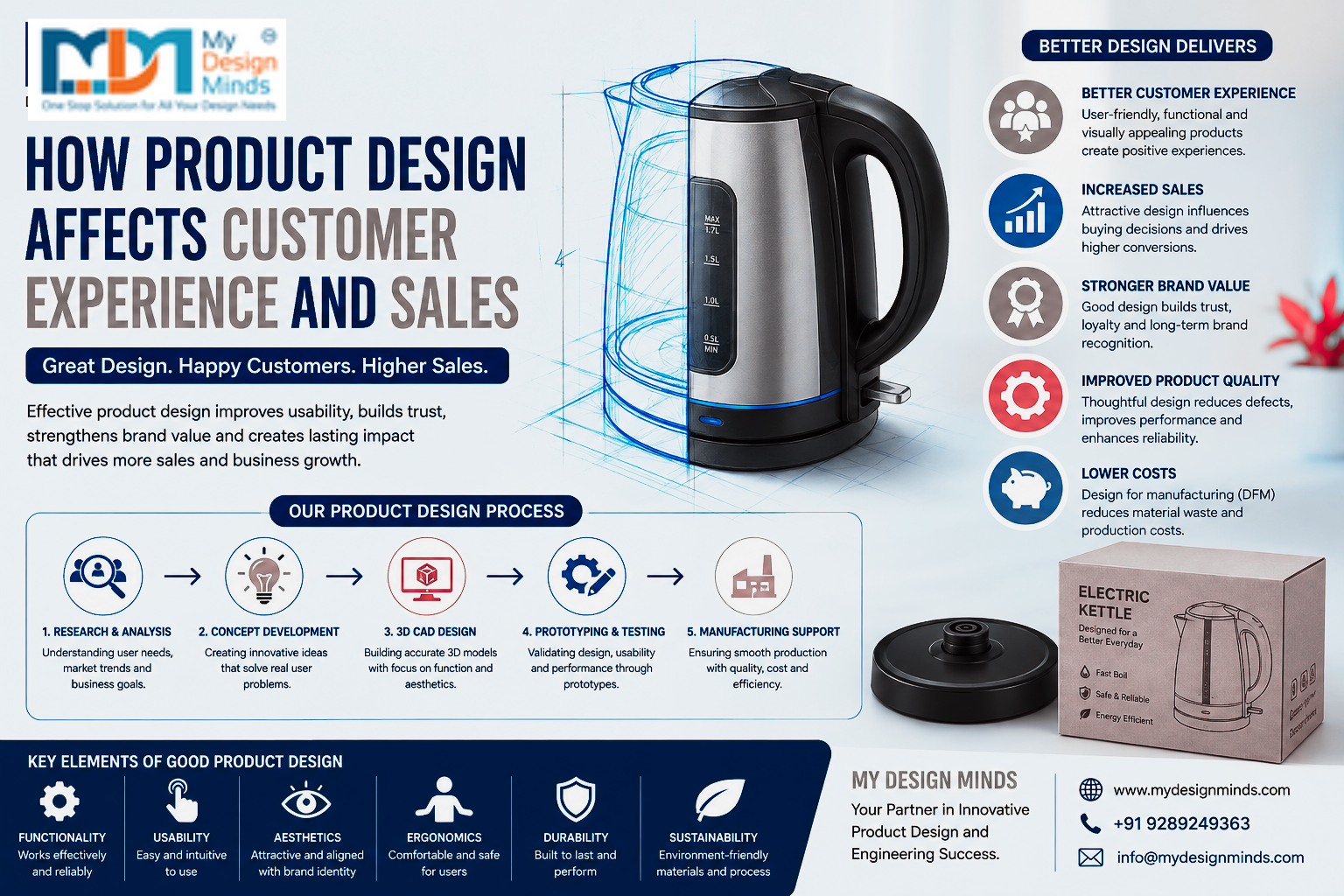
Product Design plays a major role in determining how customers perceive, use, and value a product. A product may have excellent technical capabilities, but if it is difficult to use, uncomfortable, unattractive, or unreliable, customers may choose a competitor. Effective design brings together functionality, aesthetics, ergonomics, usability, durability, and manufacturability to create products that satisfy customer expectations.
In today’s competitive market, businesses need more than innovative ideas to increase sales. They need products that provide a positive customer experience from the first interaction through everyday use. Professional Product Design Services help businesses understand user requirements and convert them into practical, attractive, and market-ready products.
At My Design Minds, we combine creative thinking, engineering expertise, CAD technology, prototyping, and manufacturing knowledge to help businesses develop products that improve customer satisfaction and create stronger opportunities for sales growth.
What Is Product Design?
Product Design is the process of developing a product’s appearance, functionality, usability, structure, and overall user experience. It starts with understanding customer needs and continues through concept development, 3D CAD modeling, engineering validation, prototyping, testing, and manufacturing preparation.
A successful design should answer three important questions:
- Does the product solve a customer problem?
- Is it easy and comfortable to use?
- Can it be manufactured efficiently at the required quality and cost?
When these elements work together, businesses can create products that customers want to purchase and continue using.
1. Creates a Strong First Impression
Customers often form an opinion about a product within seconds. Shape, proportions, colors, materials, surface finish, and overall appearance can influence whether a customer considers a product attractive and valuable.
Professional Industrial Product Design helps businesses create visually appealing products that communicate quality and differentiate their brand from competitors.
A strong first impression can encourage customers to explore a product further and increase the likelihood of purchase.
2. Improves Product Usability
Good design makes products easier and more intuitive to use. Buttons, handles, controls, interfaces, and physical features should be positioned according to user requirements.
User-friendly products reduce confusion and frustration while improving customer satisfaction.
For example, an ergonomically designed industrial tool can be easier to hold and operate, while a consumer appliance can provide simple controls that make everyday use more convenient.
3. Enhances Customer Satisfaction
Customer satisfaction depends heavily on how effectively a product performs its intended function. A well-designed product should be reliable, comfortable, durable, and easy to maintain.
Through User-Centered Design, businesses can consider customer expectations throughout the development process. Research, feedback, prototypes, and usability testing help identify problems before products reach the market.
4. Builds Brand Value
Products are an important representation of a company’s brand. Consistent design language across multiple products can create stronger brand recognition.
High-quality design can communicate:
- Innovation
- Reliability
- Professionalism
- Quality
- Technology
- Customer focus
When customers associate a brand with well-designed products, they may be more likely to trust and recommend the company.
5. Increases Perceived Product Value
Customers do not always judge value based solely on functionality or price. Appearance, materials, ergonomics, convenience, and overall experience can influence perceived value.
Professional design can make a product appear more premium and justify a stronger market position when supported by genuine quality and performance.
6. Reduces Product Development Risks
Design problems discovered after production can be expensive to correct. Changes may require new tooling, manufacturing adjustments, additional materials, or product recalls.
A structured Product Development approach identifies potential issues earlier through CAD modeling, engineering analysis, and prototype testing.
This helps businesses reduce redesign costs and improve confidence before entering mass production.
7. Supports Better Manufacturing
Good design must also consider how a product will be manufactured. Design for Manufacturing (DFM) helps designers simplify components, optimize material usage, reduce unnecessary complexity, and improve assembly.
Better manufacturability can result in:
- Lower production costs
- Reduced material waste
- Faster assembly
- Fewer defects
- Improved production consistency
These benefits can support competitive pricing while maintaining product quality.
8. Encourages Repeat Purchases
A positive customer experience can influence future buying decisions. When customers find a product reliable, convenient, attractive, and easy to use, they are more likely to purchase from the same brand again.
Satisfied customers may also recommend products to friends, colleagues, or through online reviews, creating additional opportunities for organic sales growth.
9. Helps Businesses Stand Out From Competitors
Many markets contain products with similar technical features. Design can become an important differentiator.
A unique combination of functionality, aesthetics, ergonomics, and convenience can give a product a competitive advantage.
Professional Industrial Product Design helps businesses identify opportunities to improve existing products and create meaningful differentiation.
10. Supports Faster Time-to-Market
An organized design workflow can accelerate product development. Digital CAD models, rapid prototyping, simulation, and design validation allow teams to identify and resolve problems before production.
Faster development enables businesses to respond to market trends and customer demands more quickly.
How My Design Minds Improves Product Design
At My Design Minds, we provide complete Product Design Services for businesses looking to develop innovative, functional, and manufacturing-ready products.
Our capabilities include:
- Industrial Product Design
- Concept Development
- 3D CAD Modeling
- Mechanical Design
- Engineering Analysis
- Reverse Engineering
- Prototype Development
- Design for Manufacturing
- Product Optimization
- Manufacturing Support
Our designers and engineers work together to balance customer requirements, technical performance, aesthetics, cost, and manufacturability.
Why Choose My Design Minds?
Businesses can benefit from our:
- Experienced design and engineering team
- Advanced CAD capabilities
- Customer-focused design approach
- Prototype and validation support
- Manufacturing-oriented solutions
- Cost-effective development services
- End-to-end product development expertise
We help businesses transform ideas into products designed for real users and real manufacturing environments.
Conclusion
Product Design directly influences customer experience, perceived value, brand reputation, and sales performance. From appearance and ergonomics to functionality, reliability, and manufacturability, every design decision can affect how customers interact with and evaluate a product.
Investing in professional Product Design Services enables businesses to create products that are easier to use, more attractive, reliable, and competitive. With concept development, CAD modeling, prototyping, engineering validation, and DFM, companies can reduce development risks while improving their chances of market success.
At My Design Minds, we provide innovative Industrial Product Design and engineering solutions that help businesses create customer-focused, production-ready products. Whether you are developing a completely new product or improving an existing one, our team can help turn your ideas into designs that deliver better experiences and stronger business results.