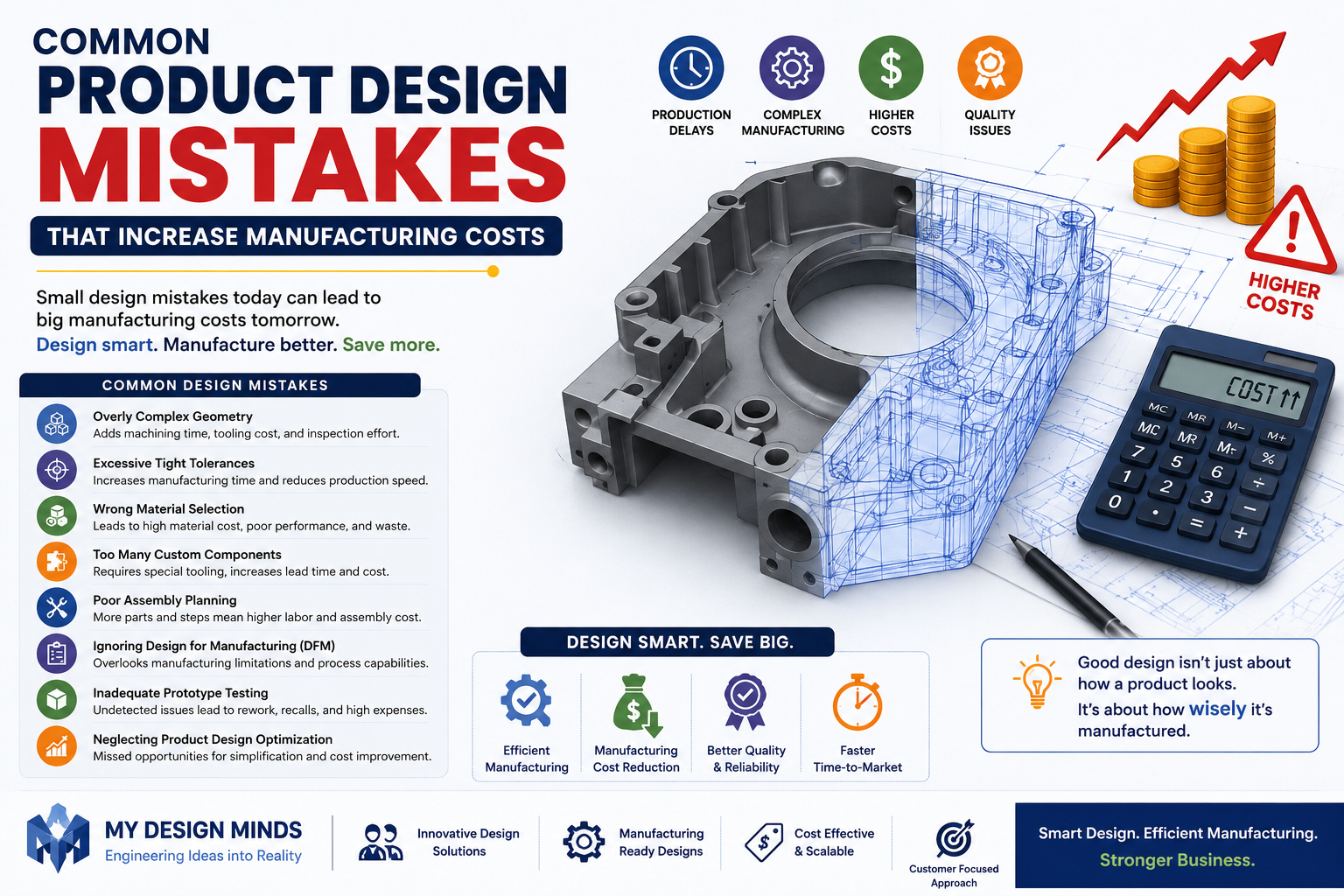
Design is the foundation of every successful product, but even small errors during development can significantly increase production expenses. Many businesses focus on aesthetics and functionality while overlooking manufacturability, material selection, and assembly efficiency. These oversights often result in delays, higher production costs, quality issues, and unnecessary design revisions.
Understanding Common Product Design Mistakes helps manufacturers create products that are easier to produce, cost-effective, and scalable. By considering production requirements early in the design process, companies can minimize waste, reduce manufacturing complexity, and improve overall product performance.
Ignoring Design for Manufacturing Principles
One of the biggest mistakes businesses make is failing to incorporate Design for Manufacturing from the beginning. A product may appear perfect in CAD software but prove difficult or expensive to manufacture.
Designers often create complex geometries that require specialized tooling, multiple machining operations, or custom manufacturing processes. Simplifying components and designing with production capabilities in mind ensures faster manufacturing, fewer errors, and better consistency.
Considering manufacturing limitations during product development reduces production time while improving product reliability.
Overcomplicated Product Geometry
Complex designs increase machining time, tooling requirements, inspection effort, and assembly complexity. Every additional feature, tight corner, or unnecessary contour contributes to higher manufacturing expenses.
Keeping designs simple without sacrificing functionality improves efficiency and supports Manufacturing Cost Reduction across the entire production cycle.
Whenever possible, eliminate unnecessary features, standardize dimensions, and reduce the number of unique parts. Simpler products are easier to manufacture, inspect, and maintain.
Choosing the Wrong Materials
Material selection directly affects manufacturing cost, durability, machining time, and product lifespan.
Many companies choose premium materials even when standard engineering materials provide similar performance. Others ignore manufacturing compatibility, resulting in excessive tool wear or difficult fabrication.
Proper material selection balances performance, availability, sustainability, and cost. Engineers should always evaluate multiple material options before finalizing product specifications.
Excessive Tight Tolerances
Tight tolerances improve precision only when truly required. Applying extremely strict tolerances across every component forces manufacturers to use more precise machining processes, additional inspections, and slower production speeds.
Instead, identify only the critical dimensions that require precision while allowing standard tolerances elsewhere. This approach reduces machining costs without compromising product quality.
Smart tolerance management is an essential part of Product Design Optimization because it balances quality with production efficiency.
Too Many Custom Components
Custom-designed parts often require dedicated tooling, unique suppliers, longer lead times, and higher procurement costs.
Whenever practical, designers should use standard fasteners, bearings, connectors, and commercially available components. Standardization reduces inventory complexity and simplifies maintenance for customers.
It also improves supply chain resilience by allowing manufacturers to source parts from multiple vendors.
Poor Assembly Planning
Products that require excessive assembly steps increase labor costs and production time.
Design teams sometimes create products with unnecessary fasteners, difficult-to-access joints, or complicated installation sequences. These issues slow assembly lines and increase the likelihood of human error.
Good assembly planning minimizes component count, improves accessibility, and reduces installation time. Following Design for Manufacturing guidelines helps create products that are faster and easier to assemble while maintaining consistent quality.
Ignoring Manufacturing Process Limitations
Every manufacturing method has limitations. Injection molding, CNC machining, sheet metal fabrication, casting, and 3D printing each require different design considerations.
Ignoring these limitations often leads to production delays, expensive tooling modifications, or complete redesigns.
Collaborating with manufacturing engineers during the design phase ensures products align with production capabilities and avoids unnecessary engineering changes later.
Inadequate Prototype Testing
Skipping prototype validation to accelerate product launch is a costly mistake.
Prototype testing identifies design flaws before mass production begins. Issues related to strength, fit, functionality, thermal performance, and manufacturability become significantly more expensive to correct after production starts.
Early testing supports Manufacturing Cost Reduction by preventing expensive recalls, warranty claims, and redesign efforts.
Neglecting Product Design Optimization
Product development should be an iterative process rather than a one-time activity.
Continuous Product Design Optimization allows engineers to improve materials, simplify manufacturing processes, reduce part count, and enhance overall product performance. Small design improvements often generate substantial long-term savings throughout the product lifecycle.
Regular design reviews involving engineering, manufacturing, procurement, and quality teams create products that balance innovation with practical production requirements.
Conclusion
Avoiding Common Product Design Mistakes requires collaboration between designers, engineers, and manufacturing experts. Products designed with production efficiency in mind are easier to manufacture, less expensive to assemble, and more competitive in today’s market.
By focusing on simplified geometry, appropriate material selection, realistic tolerances, standard components, and early prototype validation, businesses can reduce production costs while improving product quality and customer satisfaction. Investing in smarter design decisions today creates long-term operational savings and stronger business growth.
Why Choose My Design Minds?
Successful product development goes beyond creating visually appealing concepts – it requires engineering expertise that supports efficient manufacturing and long-term product performance. At My Design Minds, we combine innovation with practical design strategies to help businesses transform ideas into market-ready products. Our team focuses on manufacturability, precision engineering, cost-effective material selection, and production-ready designs that minimize risks and maximize value. Whether you’re developing a new product or improving an existing one, My Design Minds delivers customized design solutions that enhance quality, reduce manufacturing costs, accelerate product launches, and support sustainable business growth through intelligent engineering and customer-focused product development.