In today’s competitive manufacturing landscape, speed and innovation determine business success. Companies need faster ways to transform ideas into market-ready products while minimizing costs and reducing development risks. This is where 3D Printing for Product Development has become a game-changing technology.
3D printing, also known as additive manufacturing, enables engineers and designers to create highly accurate prototypes directly from CAD models. Whether you’re developing consumer products, automotive components, medical devices, or industrial equipment, rapid prototyping helps validate designs before investing in expensive tooling and mass production.
In this blog, we’ll explore the major benefits of 3D Printing , why businesses are adopting it, and how it accelerates innovation.
What is 3D Printing in Product Development?
3D printing is an additive manufacturing process that builds physical objects layer by layer using digital CAD files. Unlike traditional manufacturing methods that remove material, 3D printing creates components only where needed, reducing waste and production time.
It is widely used during product development for:
- Concept models
- Functional prototypes
- Design validation
- Fit and assembly testing
- Engineering evaluation
- Small-batch production
The technology allows businesses to evaluate a product before committing to costly manufacturing processes.
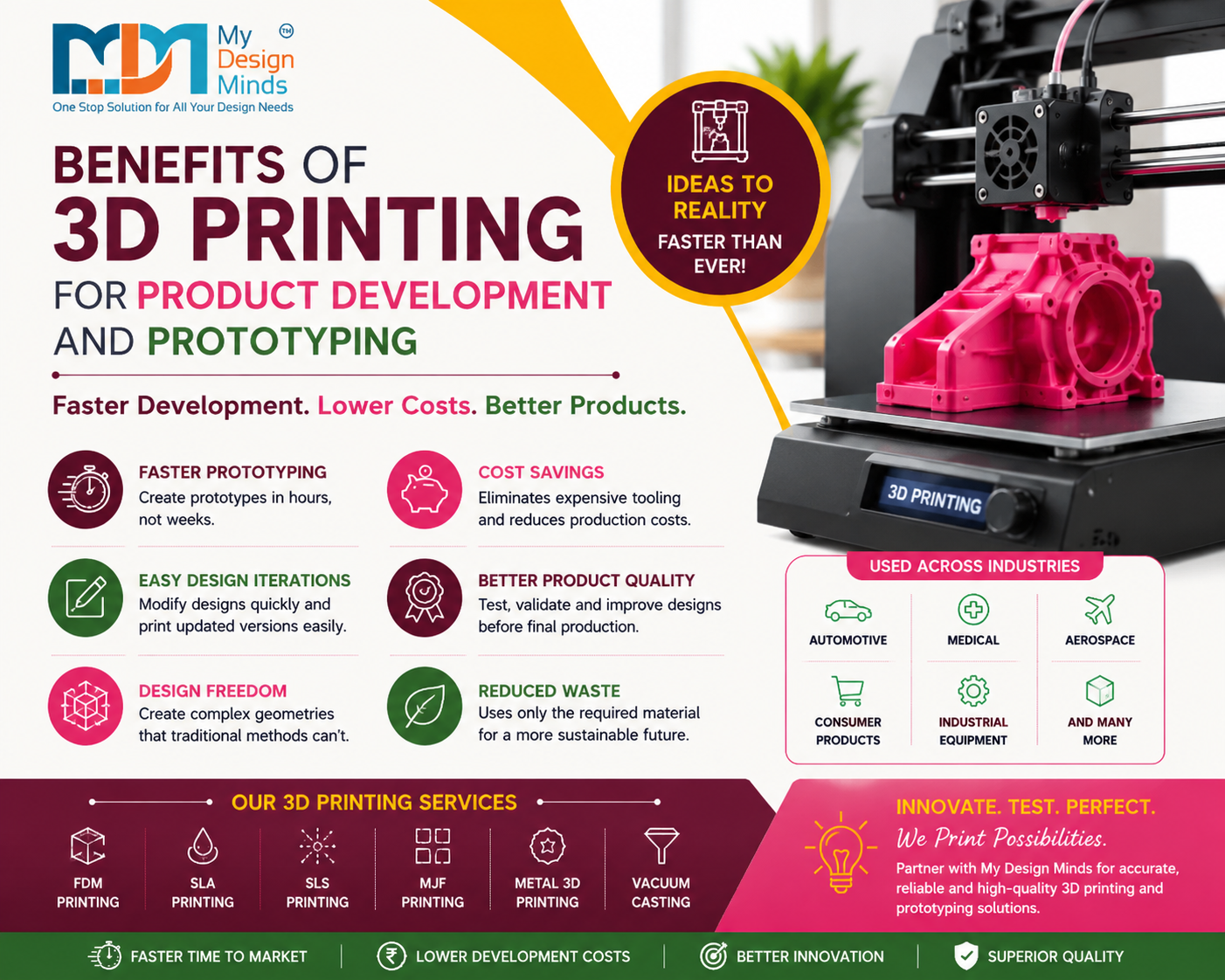
1. Faster Product Development
One of the biggest advantages of 3D Printing for Product Development is speed.
Traditional prototype manufacturing may take weeks because it requires machining, moulds, or specialized tooling. With 3D printing, prototypes can often be produced within hours or a few days.
Benefits include:
- Faster design iterations
- Reduced product development cycles
- Quicker customer approvals
- Faster market launch
Businesses can test multiple versions of a design without waiting for lengthy manufacturing processes.
2. Significant Cost Savings
Creating prototypes using CNC machining or injection moulds can be expensive, especially during the early design stages.
3D printing reduces costs by eliminating:
- Prototype tooling
- Complex machining
- Multiple setup charges
- Material wastage
Since only the required material is used, manufacturers spend less while obtaining accurate prototypes.
This makes 3D printing ideal for startups, SMEs, and large manufacturers alike.
3. Easy Design Modifications
Product development involves continuous improvements.
With traditional manufacturing, even small design changes often require new tooling or expensive machining.
Using 3D Printing, engineers simply modify the CAD model and print an updated version.
Advantages include:
- Instant design revisions
- Lower engineering costs
- Improved flexibility
- Faster innovation
This allows businesses to experiment with multiple concepts before finalizing the design.
4. Improved Design Validation
A digital model cannot always reveal real-world design issues.
Physical prototypes help engineers evaluate:
- Size
- Ergonomics
- Functionality
- Assembly
- Structural integrity
- User experience
Testing actual components helps identify design flaws early, reducing costly production errors.
5. Better Product Quality
Finding problems before production greatly improves final product quality.
3D printed prototypes help validate:
- Dimensions
- Wall thickness
- Material selection
- Mechanical performance
- Component interactions
This results in fewer manufacturing defects and higher customer satisfaction.
6. Complex Designs Become Possible
Traditional manufacturing often limits design freedom.
3D printing allows engineers to manufacture complex geometries that would be difficult or impossible using conventional methods.
Examples include:
- Internal channels
- Lightweight lattice structures
- Organic shapes
- Complex assemblies
- Customized components
This opens new possibilities for innovative product development.
7. Reduced Material Waste
Sustainability has become an important factor in manufacturing.
Unlike subtractive manufacturing processes, additive manufacturing uses only the required material.
Benefits include:
- Less raw material consumption
- Lower production waste
- Reduced environmental impact
- Improved resource efficiency
This makes 3D printing an environmentally friendly manufacturing solution.
8. Functional Testing Before Production
Modern 3D printing materials closely simulate production-grade plastics and metals.
Businesses can perform:
- Mechanical testing
- Load testing
- Thermal testing
- Assembly validation
- Performance evaluation
Testing functional prototypes helps avoid costly production failures later.
9. Better Customer Communication
Physical prototypes improve collaboration between manufacturers and customers.
Instead of reviewing only CAD drawings, clients can:
- Hold the prototype
- Check dimensions
- Evaluate appearance
- Suggest modifications
- Approve designs faster
This reduces misunderstandings and improves customer satisfaction.
10. Supports Multiple Industries
3D Printing is used across numerous industries, including:
Automotive
- Dashboard components
- Interior trims
- Functional prototypes
- Air ducts
Medical
- Surgical models
- Medical devices
- Prosthetics
- Customized implants
Consumer Products
- Electronics enclosures
- Kitchen appliances
- Wearables
- Packaging prototypes
Industrial Equipment
- Machine components
- Tooling
- Fixtures
- Jigs
Aerospace
- Lightweight parts
- Complex assemblies
- Design validation
- Performance testing
11. Accelerates Innovation
Companies that innovate faster gain a competitive advantage.
Rapid prototyping enables organizations to:
- Test more ideas
- Validate concepts quickly
- Improve products continuously
- Launch products ahead of competitors
This innovation cycle drives long-term business growth.
12. Supports Low-Volume Manufacturing
Besides prototyping, 3D printing is also suitable for:
- Pilot production
- Custom products
- Spare parts
- Limited-edition products
- Replacement components
Manufacturers can produce small batches without investing in expensive tooling.
Popular 3D Printing Technologies
Depending on the application, different technologies are available:
- FDM (Fused Deposition Modeling) – Cost-effective concept models and functional prototypes.
- SLA (Stereolithography) – High-detail prototypes with smooth finishes.
- SLS (Selective Laser Sintering) – Strong engineering-grade plastic parts.
- MJF (Multi Jet Fusion) – Durable prototypes with excellent mechanical properties.
- Metal 3D Printing – Functional metal components for industrial applications.
- Vacuum Casting – Ideal for low-volume production after prototype approval.
Selecting the right technology depends on the required accuracy, strength, material, and end use.
Why Choose My Design Minds for 3D Printing Services?
At My Design Minds, we provide end-to-end 3D Printing for Product Development services for startups, manufacturers, OEMs, and engineering companies across India and global markets.
Our capabilities include:
- Product design support
- CAD modeling
- Functional prototyping
- SLA, SLS, MJF, FDM, and Metal 3D Printing
- Vacuum casting
- Design optimization
- Reverse engineering
- Manufacturing support
Our experienced engineering team ensures every prototype is manufactured with precision, helping businesses reduce development time and improve product quality.
Conclusion
The benefits of 3D Printing for Product Development extend far beyond rapid prototyping. It enables faster innovation, lower costs, improved product quality, reduced waste, and greater design flexibility. By allowing engineers to test, refine, and validate products before production, businesses can minimize risks and accelerate time-to-market.
Whether you’re developing a new consumer product, industrial equipment, automotive component, or medical device, 3D printing provides the speed and accuracy needed to stay competitive. My Design Minds offers comprehensive 3D printing and prototyping solutions that help businesses transform concepts into high-quality, production-ready products efficiently and cost-effectively.
