
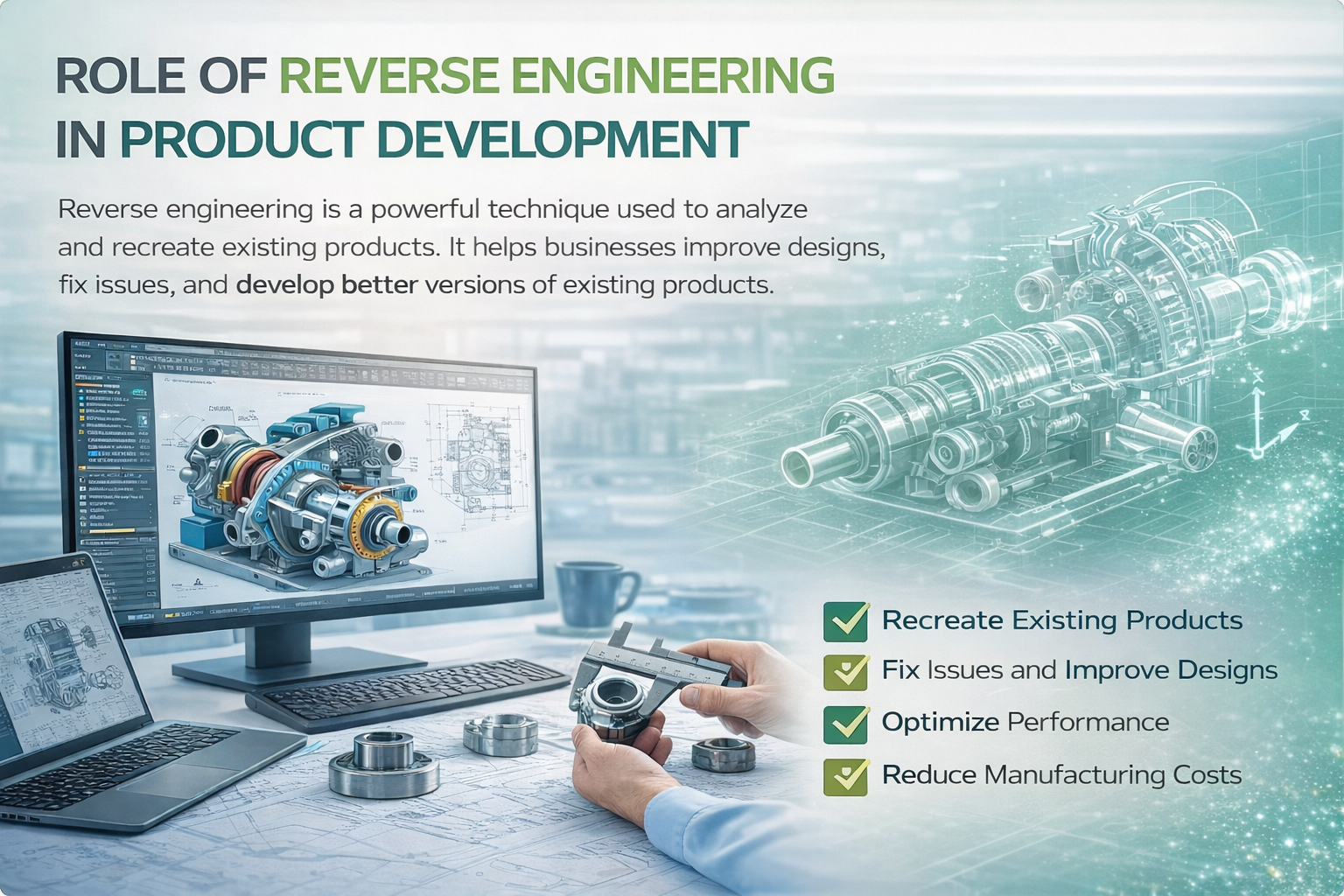
In today’s competitive manufacturing environment, innovation and efficiency are key to success. One of the most effective techniques helping businesses achieve both is Reverse Engineering in Product Development. It allows companies to analyze existing products, understand their design, and recreate improved versions with better performance and functionality.
product redesign process is widely used across industries such as automotive, aerospace, electronics, and industrial manufacturing. It provides valuable insights into product structure, materials, and working mechanisms, enabling businesses to enhance quality and reduce costs.
What is Reverse Engineering?
Reverse engineering is the process of deconstructing a product to understand its design, components, and functionality. Engineers use advanced tools such as 3D scanning, CAD software, and measurement systems to recreate digital models of physical products.
With the help of CAD reverse engineering, companies can convert physical objects into accurate digital designs. This is especially useful when original design data is missing or outdated.
Importance of Reverse Engineering in Product Development
1. Product Analysis and Understanding
product benchmarking method in Product Development helps businesses gain a deeper understanding of existing products. This includes identifying design features, material selection, and manufacturing processes.
2. Product Design Improvement
One of the biggest advantages is product design improvement. Engineers can identify flaws or inefficiencies in the existing design and develop enhanced versions with better performance and durability.
3. Cost Reduction
By optimizing designs and eliminating unnecessary components, companies can significantly reduce manufacturing costs. This makes product redesign services highly valuable for businesses looking to improve profitability.
Key Benefits of Reverse Engineering
Faster Product Development
Using CAD product redesign process, engineers can quickly create digital models, reducing the time required for design and development.
Improved Accuracy
Modern tools ensure high precision in measurements and modeling, making Reverse Engineering in Product Development a reliable approach for accurate product recreation.
Enhanced Innovation
product redesign process allows companies to study competitor products and develop innovative solutions. This leads to better product design improvement and market competitiveness.
Legacy Product Support
Many industries rely on old machinery with no available design data. product redesign services help recreate parts and extend the life of such equipment.
Process of product redesign
1. Data Collection
The process begins with capturing the physical product data using 3D scanners or measuring tools.
2. Digital Modeling
The collected data is converted into a digital model using CAD reverse engineering techniques.
3. Design Analysis
Engineers analyze the model to identify improvements and optimize performance.
4. Prototype Development
A prototype is created to test the improved design before final production.
5. Final Production
Once validated, the product is manufactured with enhanced features and efficiency.
Applications Across Industries
product redesign in Product Development is widely used in:
- Automotive industry for spare parts and design upgrades
- Aerospace sector for precision components
- Medical industry for customized implants
- Manufacturing sector for equipment optimization
These applications highlight the importance of product design improvement in achieving high-quality results.
Why Choose Professional product benchmarking Services?
Working with experts ensures accuracy, efficiency, and reliability. Professional product redesign services use advanced tools and experienced engineers to deliver precise results.
At My Design Minds, we provide cutting-edge solutions tailored to your business needs. Our team specializes in CAD reverse engineering, ensuring accurate modeling and optimized product performance.
Future of product redesign
With advancements in AI, automation, and 3D scanning technologies, the future of product redesign in Product Development looks promising. These innovations will further improve accuracy, reduce costs, and accelerate product development cycles.
Businesses that adopt these technologies will gain a competitive edge in the market by delivering high-quality and innovative products.
Conclusion
Reverse Engineering in Product Development is a powerful tool for innovation, cost reduction, and design optimization. It enables businesses to analyze existing products, improve performance, and develop better solutions.
With the support of advanced product redesign services, companies can achieve faster development, improved accuracy, and enhanced product design improvement. Leveraging CAD reverse engineering ensures precise digital models and efficient manufacturing processes.
If you want to stay ahead in today’s competitive market, investing in product redesign process is a smart and strategic decision.
