Introduction
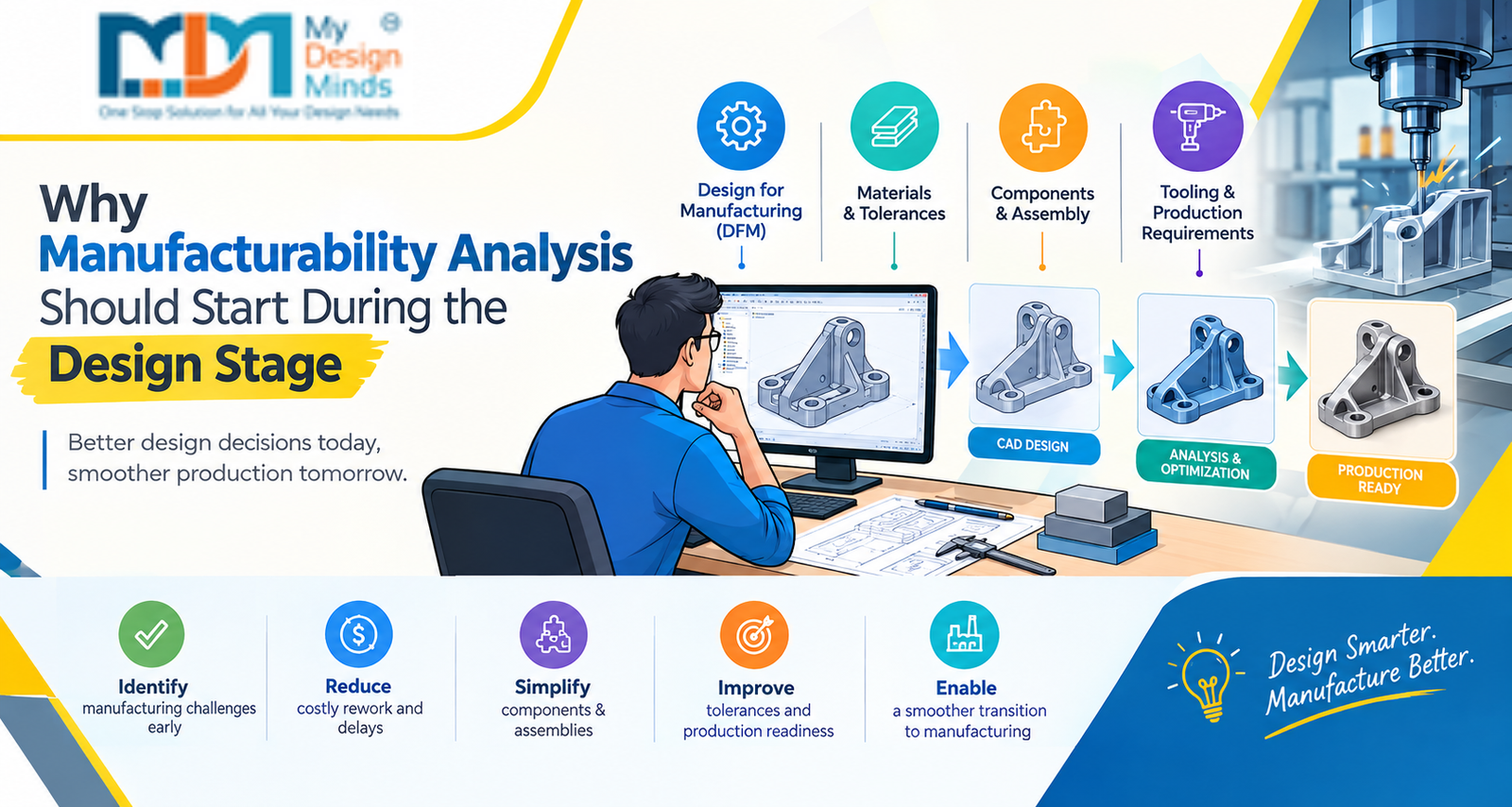
A product may look excellent on a digital model, but that does not always mean it will be easy or economical to manufacture. Manufacturing challenges often originate during the design stage when decisions about materials, dimensions, components, tolerances, and production methods are being made.
Manufacturability Analysis helps engineers evaluate whether a product design can be produced efficiently, reliably, and at an acceptable cost before manufacturing begins. Starting this evaluation early gives design teams an opportunity to identify potential production problems while changes are still relatively easy to make.
For manufacturers, startups, and product developers, integrating manufacturability into the design process can improve product quality and reduce unnecessary development costs.
What Is Manufacturability Analysis?
Manufacturability analysis is the process of examining a product design to determine whether it can be manufactured effectively using the intended production methods, materials, equipment, and processes.
Engineers may review component geometry, wall thickness, tolerances, parting lines, holes, features, assembly requirements, material selection, and tooling considerations.
The objective is not simply to determine whether a component can be manufactured. It is also to understand whether it can be manufactured consistently, efficiently, and economically at the required production volume.
Identifying Problems Before Production
One of the primary advantages of early manufacturability evaluation is that it can reveal design problems before they become manufacturing problems.
A component may contain difficult-to-machine features, unnecessarily tight tolerances, complicated geometries, or areas that are difficult to access during assembly. If these issues are discovered after tooling or production has started, correcting them may require additional time and investment.
By incorporating Design for Manufacturing principles during product development, engineers can review these concerns while the design is still being refined.
Reducing Development Costs
Late-stage design changes can be expensive. Once tooling, moulds, fixtures, raw materials, or production processes have been established, even a small design modification may affect several downstream activities.
Early analysis allows engineers to consider alternative solutions before these commitments are made.
For example, a design team may identify an opportunity to simplify a component, reduce the number of parts, modify a feature, or adjust a manufacturing tolerance. Such changes can potentially reduce tooling complexity and production costs.
Improving Product Quality
Manufacturability is closely connected with product quality. A design that is difficult to manufacture consistently may increase the possibility of defects, dimensional variation, assembly problems, or rework.
A structured review helps engineers understand how design decisions affect the production process. Appropriate tolerances, suitable materials, accessible features, and practical component geometry can contribute to more consistent manufacturing.
This makes Manufacturing Feasibility Analysis valuable not only for controlling costs but also for supporting reliable production.
Choosing the Right Manufacturing Process
Different product designs may require different manufacturing processes. Depending on the application and production volume, options can include injection moulding, CNC machining, sheet metal fabrication, casting, extrusion, 3D printing, or other specialised processes.
The design should be developed with the selected manufacturing method in mind.
For example, a component designed for injection moulding may require appropriate draft angles, wall thickness, ribs, bosses, and parting-line considerations. Similarly, machined components may require attention to tool access, material removal, tolerances, and machining complexity.
Early manufacturability review helps connect product requirements with practical production methods.
Supporting Better Material Selection
Material selection can influence both product performance and manufacturability. A material may provide excellent strength or durability but require a more complex or expensive manufacturing process.
Engineers can compare material properties with manufacturing requirements and expected production conditions.
Considering material availability, processing requirements, finishing, durability, and cost during the design stage can help create a more balanced product solution.
Simplifying Assembly
Manufacturing does not end when individual components are produced. The parts must also be assembled into a functional product.
A design with excessive components, complicated fastening methods, or difficult assembly sequences can increase production time and labour requirements.
Product Design Optimization can help simplify assemblies by reducing unnecessary parts, improving component interfaces, and making assembly operations more straightforward.
Simplified assembly can also make maintenance and future servicing easier.
Improving Communication Between Teams
Product development often involves designers, engineers, manufacturers, suppliers, and clients. Each group may have different priorities and technical concerns.
Early manufacturability discussions create an opportunity for these teams to share their requirements before the design is finalised.
CAD models, drawings, specifications, and manufacturing feedback can provide a common reference for technical discussions. This helps reduce misunderstandings and makes it easier to make informed design decisions.
Supporting Faster Time to Market
Design changes become progressively more disruptive as a project moves toward production. Addressing manufacturing concerns early can reduce the number of unexpected changes during tooling, prototyping, and production preparation.
This can create a smoother transition from digital design to physical production.
For companies operating in competitive markets, a more organised development process can help reduce avoidable delays and allow teams to focus on testing, validation, and production readiness.
Why Early Analysis Matters
Manufacturability Analysis should not be treated as a final inspection performed just before manufacturing. It is most useful when integrated throughout the product design process.
Regular reviews allow engineers to evaluate design changes as they occur and ensure that manufacturing requirements remain part of the development discussion.
When design, engineering, and manufacturing considerations are addressed together, businesses can develop products that are not only technically functional but also practical to produce.
My Design Minds
My Design Minds provides integrated product design, engineering, prototyping, and manufacturing support for businesses developing industrial and commercial products. Our Manufacturability Analysis approach helps identify potential production challenges during the design stage. We apply Design for Manufacturing principles to review product geometry, materials, tolerances, components, tooling, and manufacturing requirements. Our Manufacturing Feasibility Analysis helps clients evaluate whether proposed designs are practical for their intended production processes. Through Product Design Optimization, we support improvements that can simplify components, reduce unnecessary complexity, improve assembly, and minimise rework. By combining CAD design, product engineering, prototyping, and manufacturing knowledge, My Design Minds helps businesses move more efficiently from concept to production-ready products while keeping manufacturability in focus from the beginning.