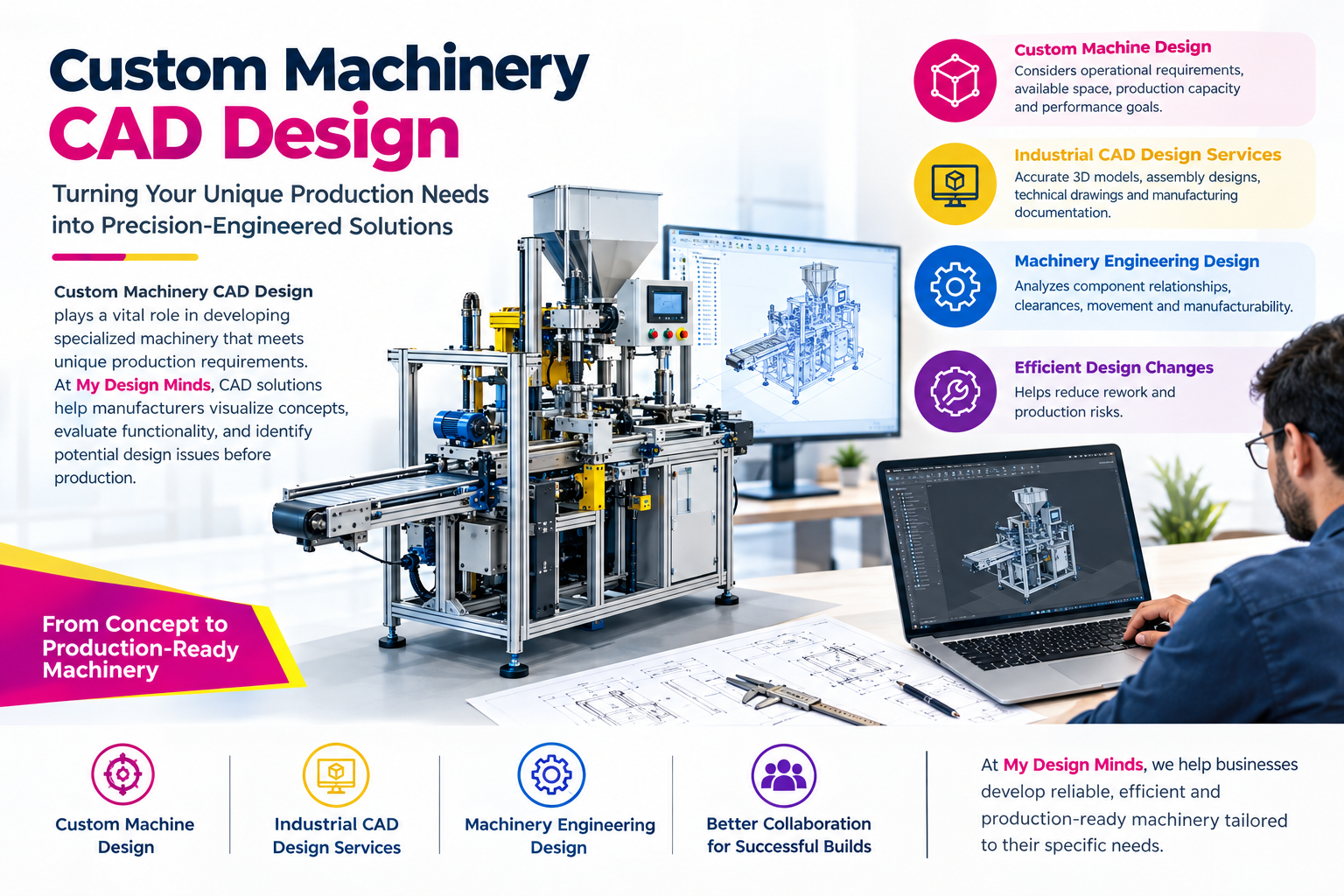
Manufacturers often require machinery that can perform specialized operations, fit into limited production spaces, or integrate with existing systems. Standard equipment may not always meet these requirements. Custom machinery provides a solution, but developing specialized equipment requires careful planning, engineering, and accurate documentation.
Custom Machinery CAD Design helps manufacturers transform machine concepts into detailed digital models that can be evaluated and refined before fabrication. From individual components to complete assemblies, CAD technology supports the development of accurate and practical equipment.
1. Turning Concepts Into Detailed Designs
Custom machinery usually begins with an idea, sketch, specification, or description of the required operation. CAD software allows engineers to transform these concepts into detailed three-dimensional models.
The digital model can represent individual components, assemblies, mechanisms, mounting points, and other important features. This provides a clearer understanding of how the proposed machinery will look and function.
2. Supporting Custom Machine Requirements
Every manufacturing facility can have different production requirements. Machinery may need to handle specific materials, perform unique operations, meet particular production speeds, or fit within a predefined workspace.
Custom Machine Design allows engineers to develop equipment around these requirements instead of forcing production processes to adapt to standard machinery.
Designers can consider dimensions, component configurations, operator accessibility, maintenance requirements, and integration with existing equipment.
3. Improving Design Accuracy
Precision is essential when developing industrial machinery. Incorrect dimensions or poorly positioned components can affect machine performance and create manufacturing problems.
Professional Industrial CAD Design Services help engineers create precise digital components and assemblies. Dimensions, tolerances, clearances, and relationships between parts can be evaluated before manufacturing begins.
This reduces the possibility of errors being discovered during fabrication or final assembly.
4. Detecting Component Interference
Custom machines can contain numerous moving and stationary components. If these components are not properly positioned, they may interfere with one another during operation.
CAD assembly environments allow engineers to identify potential interference and clearance problems digitally. Moving components can be evaluated to determine whether sufficient operating space is available.
Identifying these problems before fabrication can prevent costly modifications later.
5. Improving Machine Functionality
CAD design is not limited to visual representation. Engineers can use digital models to study how different mechanisms and components work together.
Machinery Engineering Design can help evaluate mechanisms, motion, component placement, structural requirements, and accessibility. This allows engineers to refine the machine before physical fabrication.
A well-developed digital model can therefore contribute to better functionality and operational efficiency.
6. Supporting Manufacturing and Fabrication
Once a machinery design has been finalized, manufacturers require accurate information for fabrication. CAD models and technical drawings can provide essential details about component dimensions, materials, manufacturing requirements, and assembly relationships.
This information helps machinists, fabricators, welders, and assembly teams understand what needs to be produced.
Accurate documentation can also reduce misunderstandings between the engineering and manufacturing departments.
7. Simplifying Design Modifications
Custom machinery frequently evolves during development. Customers may request additional features, manufacturers may recommend changes, or engineers may identify opportunities for improvement.
A structured CAD model makes modifications easier to manage. Engineers can update individual components or assemblies without completely rebuilding the machine design.
This flexibility can help manufacturers respond more quickly to changing requirements.
8. Supporting Better Collaboration
Machinery development often involves multiple stakeholders. Designers, mechanical engineers, electrical engineers, manufacturers, suppliers, and customers may all contribute to the project.
A detailed digital model provides a common reference for these teams. Everyone can review the same machine structure and discuss specific components or design requirements.
This can improve communication and reduce misunderstandings during development.
9. Reducing Development Costs
Manufacturing custom equipment without sufficient design evaluation can result in expensive mistakes. Incorrect components, poor clearances, or unsuitable configurations may require redesign and remanufacturing.
Using Custom Machinery CAD Design before fabrication allows businesses to identify and correct many problems digitally.
Although CAD development requires an initial investment, it can reduce rework, material waste, fabrication errors, and unnecessary modifications during production.
10. Supporting Maintenance and Assembly
Good machinery design should consider not only production but also maintenance and assembly. Operators and technicians may need access to specific components for inspection, replacement, or repair.
CAD models allow engineers to evaluate component accessibility and assembly sequences. This can help create equipment that is easier to maintain throughout its operating life.
11. Enabling Integration With Existing Systems
Custom machinery often needs to work alongside existing production equipment. Space restrictions, connection points, material flow, and operating sequences may all need to be considered.
CAD models can help engineers visualize how new equipment will fit into an existing production environment. This can improve planning and reduce integration challenges.
12. Creating Manufacturing-Ready Equipment
The ultimate goal of custom machinery design is to produce equipment that performs its intended function reliably and efficiently.
Industrial CAD Design Services can support the complete workflow, from concept modeling and component development to assembly design and technical documentation.
By combining CAD modeling with engineering evaluation and manufacturing knowledge, businesses can develop equipment that is better prepared for fabrication and installation.
Conclusion
Custom Machinery CAD Design provides manufacturers with a powerful foundation for developing specialized equipment. It improves design accuracy, supports customization, identifies potential interference, simplifies modifications, strengthens collaboration, and helps reduce manufacturing risks.
When CAD design is integrated with engineering and fabrication processes, manufacturers can move from concept to production with greater confidence. A structured digital development process also makes it easier to accommodate customer requirements, improve machine functionality, and prepare accurate manufacturing documentation.
For companies investing in specialized equipment, professional CAD support can make the development process more organized, efficient, and cost-effective.
At My Design Minds, our Custom Machine Design, Industrial CAD Design Services, and Machinery Engineering Design solutions help businesses develop reliable, efficient, and production-ready machinery tailored to their specific needs.