Launching a new product quickly is an important objective for manufacturers competing in today’s fast-moving markets. However, moving directly from concept to mass production can create significant risks. Design errors, assembly problems, material issues, and performance failures discovered late in the process can cause expensive delays. Prototype Development Services help manufacturers evaluate products before full-scale production, making it easier to identify problems, improve designs, and move toward manufacturing with greater confidence.
1. Identifying Design Problems Early
A product can appear perfect in a CAD model but behave differently when a physical version is created. Prototypes allow designers and engineers to evaluate dimensions, component relationships, ergonomics, functionality, and assembly requirements.
Finding these issues early is valuable because design changes are generally easier to implement before production tooling and manufacturing processes are finalized. Early problem identification can prevent costly modifications later.
2. Accelerating Product Development
Traditional product development can involve several lengthy design and manufacturing cycles. Every design change may require additional drawings, tooling, materials, and production preparation.
Rapid Prototyping provides a faster way to create physical representations of product concepts. Designers can evaluate a prototype, identify improvements, modify the digital design, and produce another version without unnecessarily delaying the entire project.
This iterative process helps teams progress toward a finalized product more efficiently.
3. Improving Design Decisions
Product development involves many decisions, including materials, dimensions, component configurations, manufacturing methods, and assembly processes. Making these decisions without physical evaluation can increase uncertainty.
Product Prototype Development gives engineers something tangible to evaluate. They can compare different design options and determine which configuration better meets the product’s requirements.
This evidence-based approach can reduce guesswork and improve the overall quality of development decisions.
4. Supporting Faster Testing
Testing is essential before a product enters full-scale manufacturing. Engineers need to understand whether the product performs as expected and whether its components work together effectively.
Prototype Testing Services allow teams to evaluate important characteristics before committing to mass production. Depending on the product, testing may involve functionality, fit, movement, strength, usability, durability, or assembly.
The results can then guide design modifications and further development.
5. Reducing Manufacturing Risks
Manufacturing problems can become particularly expensive when they are discovered after tooling has been completed. A prototype provides an opportunity to evaluate manufacturing-related considerations earlier.
Production teams can inspect the prototype and identify issues such as difficult assembly procedures, inaccessible components, poor tolerances, unsuitable materials, or unnecessary complexity.
These findings can help designers make the product easier and more economical to manufacture.
6. Improving Communication Between Teams
Product development typically involves designers, engineers, manufacturers, suppliers, and customers. Technical drawings are important, but they may not always communicate every aspect of a complex product.
A physical prototype provides a common reference that different teams can examine together. Designers can explain their intentions, while manufacturers can provide practical feedback based on production requirements.
Better communication can reduce misunderstandings and prevent unnecessary development delays.
7. Gathering Customer Feedback
Manufacturers can also use prototypes to collect feedback from potential customers and end users. A physical product provides a much clearer understanding of size, usability, appearance, and functionality than a concept description alone.
Feedback gathered at this stage can help companies identify improvements before final production.
This is particularly useful for consumer products, equipment interfaces, tools, and products where user experience influences purchasing decisions.
8. Reducing the Cost of Design Changes
Late-stage design changes can be expensive. Once molds, dies, fixtures, production lines, and inventory have been prepared, modifying the product may require significant additional resources.
Prototype development shifts more design learning toward the earlier stages of the development process. Manufacturers can experiment with different solutions before making major production investments.
This approach can help control development costs while improving product quality.
9. Supporting Better Manufacturing Preparation
Prototypes can help manufacturing teams prepare for production more effectively. They provide opportunities to review assembly sequences, component accessibility, tooling requirements, and production workflows.
Manufacturers can use this information to improve production planning before the final product enters the manufacturing stage.
When engineering and manufacturing teams collaborate during prototyping, potential production challenges can often be addressed before they affect the launch schedule.
10. Creating a More Efficient Development Cycle
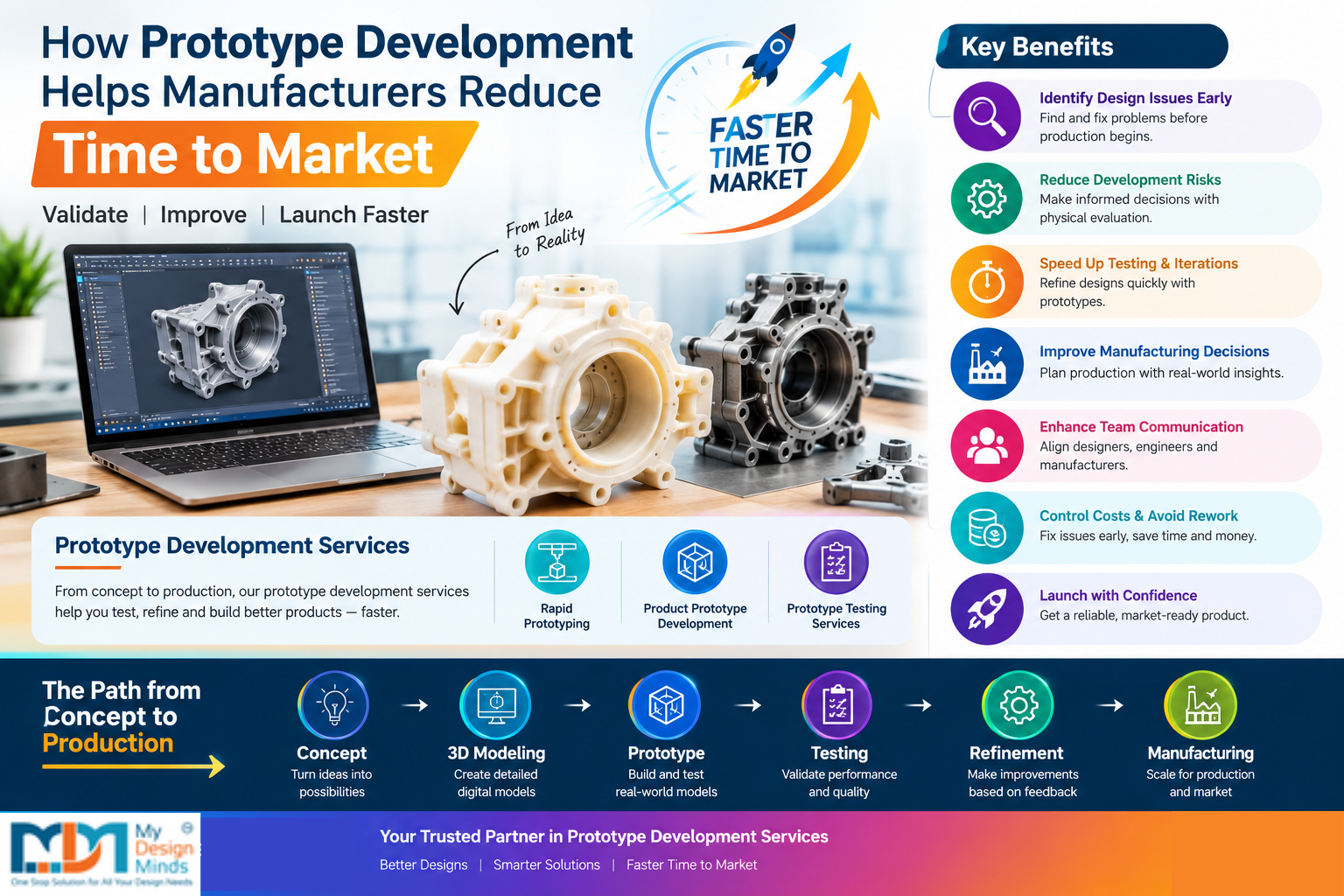
An effective development cycle typically moves through several stages: concept, CAD design, prototype, testing, refinement, validation, and manufacturing.
Each stage provides information that improves the next stage. Instead of waiting until manufacturing to discover problems, teams can use prototypes to learn earlier.
Prototype Development Services support this iterative approach by helping businesses move systematically from an initial concept toward a production-ready design.
11. Improving Time-to-Market Performance
Reducing time to market does not simply mean rushing the development process. It means removing unnecessary delays while maintaining product quality.
Efficient prototyping helps achieve this balance. When teams identify problems earlier, communicate more effectively, and make faster design decisions, the overall development timeline can become more predictable.
Rapid Prototyping can be particularly useful when several iterations are required within a limited timeframe.
12. Building Confidence Before Production
Before investing heavily in manufacturing, companies need confidence that their product will perform as expected. Product Prototype Development provides a practical opportunity to evaluate the product before making a large production commitment.
When combined with Prototype Testing Services, prototyping can help manufacturers identify weaknesses, improve functionality, and prepare a more reliable final design.
The result is a smoother transition from development to manufacturing.
Conclusion
Prototype Development Services can play an important role in helping manufacturers reduce time to market. By identifying design issues early, supporting faster testing, improving team communication, reducing manufacturing risks, and enabling efficient design iterations, prototypes make the product development process more controlled and efficient.
For manufacturers, the objective is not simply to create a prototype quickly. The real value lies in using each prototype to learn, improve, and make better decisions before production begins.
My Design Minds: Your Product Development Partner
My Design Minds provides integrated design, engineering, prototyping, and manufacturing solutions for businesses developing new products. Our team supports clients from concept development and CAD modeling through prototyping, testing, refinement, and production preparation. We help businesses evaluate product ideas, identify potential design challenges, and create practical solutions aligned with manufacturing requirements.
Our expertise in product design, reverse engineering, 3D visualization, Prototype Development Services, and manufacturing support enables a structured approach to product development. We use Rapid Prototyping and Product Prototype Development techniques to help businesses evaluate concepts, refine designs, and prepare products for manufacturing. Our Prototype Testing Services further support product evaluation and help identify potential issues before production.
Whether you are a startup bringing your first product to market or an established manufacturer improving an existing product, My Design Minds focuses on accuracy, functionality, manufacturability, and efficient development. Our goal is to help clients reduce unnecessary delays, improve product quality, and move confidently from concept to production.
