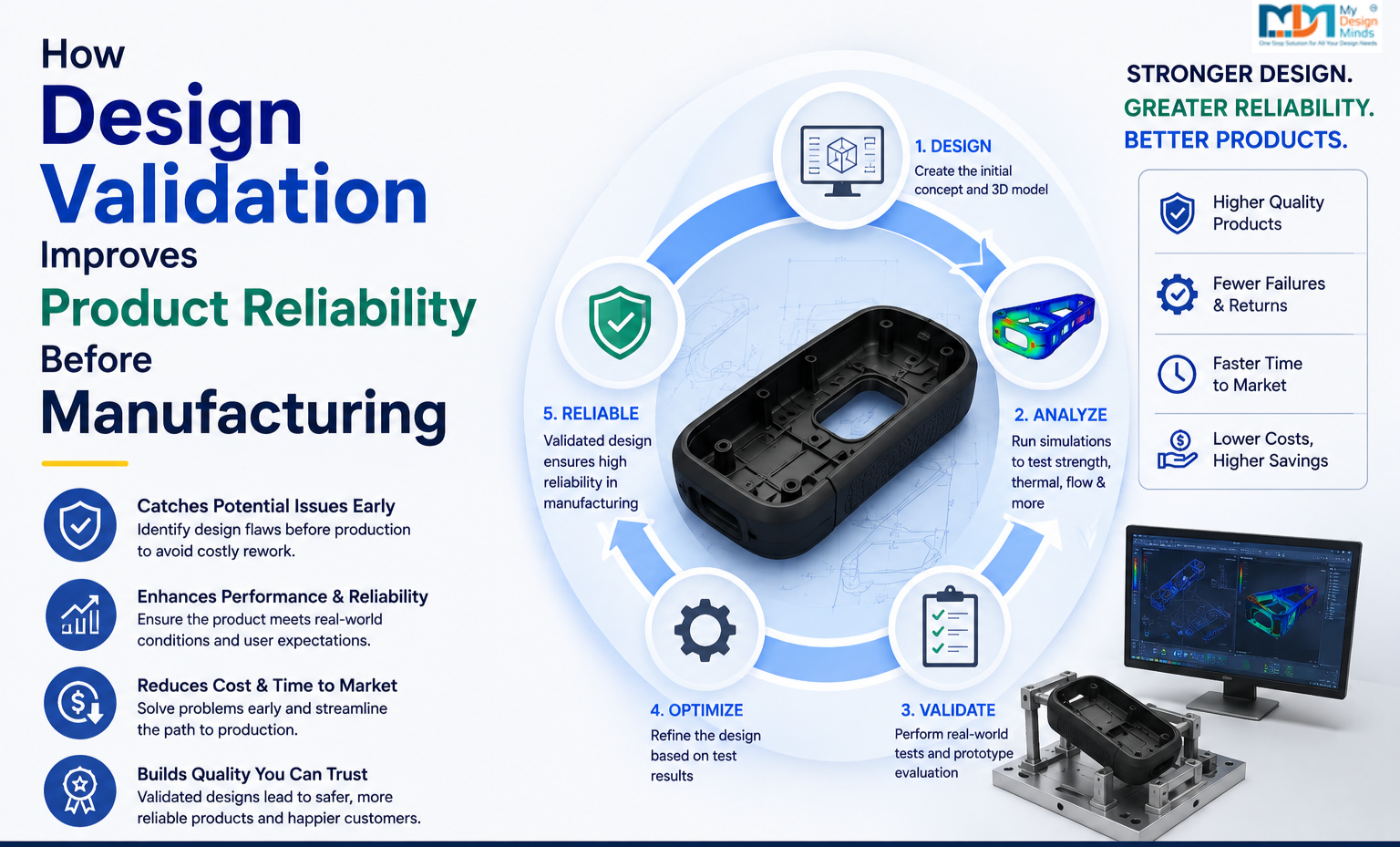
3D CAD Rendering Services play a vital role in design validation by helping manufacturers visualize, review, and improve products before manufacturing begins.Manufacturing a new product involves significant investments in materials, tooling, labor, equipment, and production time. If a design contains an error that is discovered only after manufacturing begins, correcting it can become expensive and time-consuming. Design validation provides manufacturers with an opportunity to identify potential issues before they become production problems.
A structured validation process helps engineering teams evaluate whether a product design is practical, functional, safe, and suitable for its intended manufacturing process. When combined with digital visualization and engineering analysis, it can significantly improve confidence in the final product.
Identifying Design Problems Early
One of the biggest advantages of design validation is early problem identification. During the development stage, engineers can review components, assemblies, dimensions, interfaces, and clearances to determine whether the proposed design is likely to work as intended.
3D CAD Rendering Services can support these reviews by converting technical CAD models into realistic visual representations. Engineers and stakeholders can examine the product from multiple angles and identify potential concerns that may be difficult to recognize in traditional technical drawings.Finding these issues before production allows designers to make corrections while changes are still relatively easy and affordable.
Improving Product Reliability
Product reliability depends heavily on the quality of the original design. A product with incorrect dimensions, poor component positioning, inadequate clearances, or unsuitable material selections may experience performance problems after manufacturing.
Design Validation Services help engineering teams systematically review the design against predefined requirements. Depending on the product, validation may involve dimensional checks, assembly reviews, simulations, prototype testing, material evaluation, and functional assessments.The objective is to confirm that the design can perform consistently under its expected operating conditions.
Checking Product Assembly
Complex industrial products often contain dozens or even hundreds of individual components. Even when each component is correctly designed, problems can occur when those components are assembled together.
Product Design Validation allows teams to examine how different components interact within an assembly. Engineers can review mounting points, fasteners, moving parts, interfaces, and clearances before physical production.This can help identify interference problems, inaccessible fasteners, alignment issues, and other assembly challenges at an early stage.
Supporting CAD Design Verification
Accurate digital models provide an important foundation for product validation. Engineers can compare dimensions, geometry, interfaces, and design specifications against project requirements.
CAD Design Verification helps confirm that the digital design reflects the intended engineering specifications. This can be particularly valuable for products containing precision components or complex assemblies.
Verification can also help reduce discrepancies between design documentation and the final manufacturing requirements.
Reducing Manufacturing Costs
Design errors discovered after tooling or production has started can result in substantial additional expenses. Manufacturers may need to modify tools, replace components, scrap materials, or stop production temporarily.
Early validation reduces these risks by allowing teams to identify and correct problems before manufacturing commitments are made.
Digital design reviews can therefore contribute to more efficient development and help manufacturers avoid unnecessary rework.
Improving Communication Between Teams
Product development often involves designers, engineers, manufacturers, suppliers, marketing teams, and customers. Each group may look at the product from a different perspective.
Professional 3D visuals can create a common reference that makes communication easier. Instead of relying entirely on technical terminology, teams can review a visual representation of the proposed product and discuss specific areas requiring improvement.
This is especially useful when communicating complex designs to stakeholders who may not have an engineering background.
Supporting Better Customer Approvals
Customer feedback is often essential during product development. However, customers may struggle to understand a product based solely on engineering drawings.
Realistic digital representations can make the proposed design easier to understand. Customers can review the appearance, configuration, and major design elements before manufacturing begins.
This can improve the approval process and reduce the possibility of major changes after production has started.
Minimizing Prototype and Rework Risks
Physical prototypes remain valuable for many products, but producing multiple prototypes can increase development costs and extend timelines.
Digital validation allows teams to evaluate many design aspects before committing to physical prototypes. Different configurations, dimensions, materials, and design features can be reviewed digitally.
Although digital validation does not replace every form of physical testing, it can help ensure that prototypes are based on a more mature design.
Creating a Stronger Path From Design to Manufacturing
The ultimate purpose of validation is to increase confidence before production. Engineers can combine visual reviews, dimensional verification, simulations, prototype testing, and manufacturing assessments to create a comprehensive development process.
3D CAD Rendering Services can play a supporting role by making complex designs easier to visualize and review. When integrated with engineering workflows, digital visualization helps teams communicate design intent and identify potential concerns before manufacturing.
A strong validation process can therefore help manufacturers reduce risks while improving product quality, reliability, and production readiness.
Why Design Validation Matters
Design validation is not simply an additional step in product development. It is a proactive approach to reducing uncertainty before manufacturing begins.
Design Validation Services can help businesses identify design weaknesses, improve assembly planning, and verify product requirements before production. Similarly, Product Design Validation provides greater confidence that the proposed product is ready for the next development stage.
By combining CAD Design Verification, engineering expertise, visualization, and practical manufacturing knowledge, companies can make better design decisions and reduce costly production surprises.
For manufacturers developing complex or customized products, investing time in validation before manufacturing can lead to better reliability, smoother production, fewer revisions, and stronger customer confidence.
About My Design Minds
My Design Minds provides integrated design, engineering, CAD, visualization, prototyping, and manufacturing support for businesses developing new and improved products. Our approach focuses on helping clients identify design challenges early and make informed decisions before production begins. From detailed CAD development and product visualization to engineering support and manufacturing solutions, we help transform ideas into practical products. Our team works closely with clients to understand technical requirements, product objectives, and manufacturing considerations. Whether you are developing an industrial component, machinery, consumer product, or complex assembly, My Design Minds helps create a structured path from concept and validation to production, with a strong focus on accuracy, reliability, and practical outcomes.