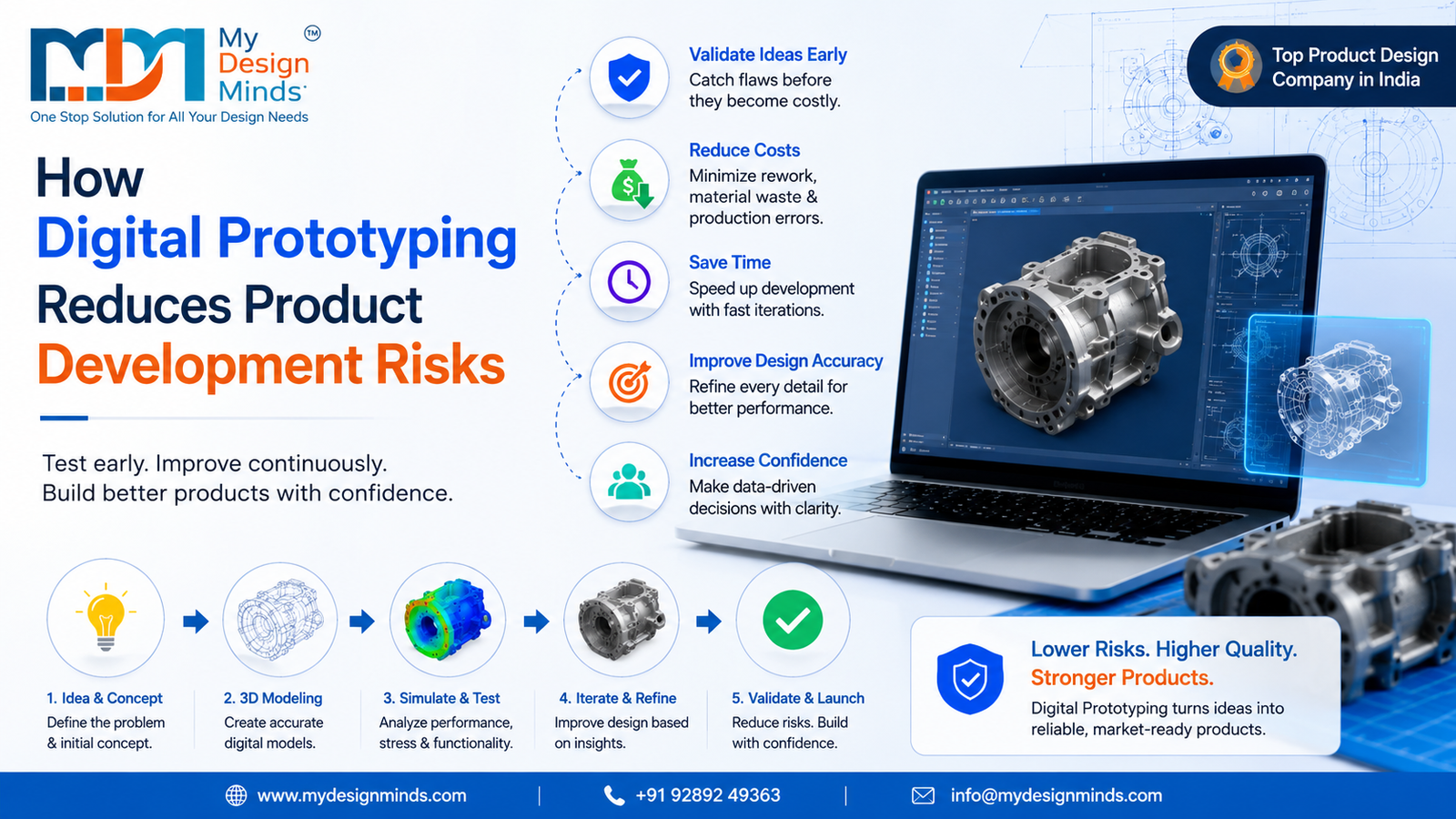
Product development involves significant investment in time, resources, engineering expertise, and manufacturing. A small design error discovered late in the development cycle can result in expensive modifications, production delays, material waste, and customer dissatisfaction. This is why businesses increasingly use Digital Prototyping Services to identify and resolve potential issues before physical production begins.
Digital prototyping allows designers and engineers to create detailed virtual representations of products, components, and assemblies. These models can be reviewed, tested, modified, and optimized digitally, helping companies make better decisions before committing to expensive tooling and manufacturing.
Identifying Design Problems Early
One of the biggest advantages of digital prototyping is the ability to identify design problems during the early stages of development. Traditional product development may require multiple physical prototypes before designers discover issues related to dimensions, functionality, assembly, or ergonomics.
With Virtual Product Prototyping, teams can examine product geometry and component relationships before creating a physical model. Designers can identify interference, clearance problems, unsuitable dimensions, and structural weaknesses much earlier.
Early identification means changes can be made quickly without wasting materials or restarting expensive manufacturing processes. This significantly reduces the technical and financial risks associated with product development.
Improving Design Validation
Design validation is essential for ensuring that a product meets its functional and performance requirements. Digital models allow engineers to evaluate different design concepts and simulate how components may behave under expected operating conditions.
Through 3D Product Prototyping, companies can review product dimensions, mechanisms, assemblies, and overall functionality in a virtual environment. Different configurations can be compared to determine which design offers the best combination of performance, usability, and manufacturability.
This approach gives product teams greater confidence before moving into physical prototyping and production.
Reducing Development Costs
Physical prototypes can be expensive, especially when products require specialized materials, complex components, or custom tooling. Producing several versions of a physical prototype can quickly increase development expenses.
Digital Prototyping Services reduce these costs by allowing teams to make numerous design iterations digitally. Instead of manufacturing a new prototype every time a change is required, designers can modify the digital model and evaluate the updated concept.
This reduces material consumption, machining costs, labor requirements, and prototype production expenses. Companies can therefore allocate more resources toward important activities such as testing, engineering, and market preparation.
Speeding Up Product Development
Time-to-market is another major factor influencing product success. Delays during design development can allow competitors to introduce similar products first or cause businesses to miss important market opportunities.
Digital workflows make product development more efficient because design modifications can be completed quickly. Engineers can collaborate around a shared digital model, review changes, and approve iterations without waiting for physical prototypes.
Digital Product Design also supports faster communication between designers, engineers, manufacturers, and other stakeholders. This helps reduce misunderstandings and minimizes delays caused by repeated design revisions.
Supporting Better Collaboration
Modern product development often involves multiple teams working from different locations. Designers may work with engineers, manufacturers, suppliers, and clients throughout the development process.
Digital prototypes provide a visual reference that makes technical discussions easier. Stakeholders can examine the same model, identify areas that need improvement, and provide feedback before manufacturing begins.
With Virtual Product Prototyping, teams can also present design concepts to non-technical stakeholders more effectively. Realistic digital models can communicate product appearance, proportions, components, and functionality more clearly than traditional drawings alone.
Improving Manufacturability
A product that looks excellent on screen may still be difficult or expensive to manufacture. Therefore, manufacturability should be considered before finalizing the design.
Digital prototypes help engineers examine factors such as wall thickness, component fit, assembly methods, material requirements, and production constraints. These evaluations can help identify features that may create manufacturing difficulties.
Using 3D Product Prototyping during development allows companies to optimize designs for their intended manufacturing process. This can reduce production complications and help create products that are easier and more economical to manufacture.
Minimizing Product Failure Risks
Product failure can damage a company’s reputation and create significant financial consequences. Problems may arise from incorrect dimensions, poor component integration, weak structures, inadequate clearances, or unsuitable design decisions.
Digital prototyping provides opportunities to identify many of these risks before production. Engineers can review the complete product digitally and make improvements before committing to physical manufacturing.
By combining visualization, design review, engineering analysis, and iterative development, companies can create products with greater reliability and consistency.
Making Product Development More Efficient with My Design Minds
For businesses looking to reduce product development risks, Digital Prototyping Services can provide a practical way to validate ideas before investing heavily in physical production. My Design Minds helps businesses transform concepts into detailed digital product models through professional design and engineering support. Its approach can support concept development, 3D modeling, design refinement, visualization, and manufacturing-oriented development. By identifying potential design and engineering issues earlier, businesses can reduce unnecessary revisions, control development costs, and improve product readiness. Whether developing a new industrial product, consumer product, or mechanical component, My Design Minds can help businesses move from an initial concept toward a more practical and manufacturable solution. This makes digital development an important step toward faster, smarter, and lower-risk product innovation.