In today’s competitive manufacturing environment, creating a functional product is no longer enough. Customers expect products that are efficient, attractive, reliable, easy to use, and cost-effective. Manufacturers must balance performance with design, usability, production requirements, and market expectations. This is where Industrial Product Design Services can play an important role in transforming ideas into commercially competitive products.
What Is Industrial Design?
Industrial design is the process of developing a product’s appearance, functionality, usability, materials, dimensions, and overall user experience. It combines creativity with engineering principles to ensure that a product is not only visually appealing but also practical to manufacture and use.
From consumer products and industrial equipment to automotive components and specialized machinery, professional industrial design solutions help manufacturers create products that address specific customer needs while maintaining production efficiency.
Why Industrial Design Matters for Manufacturers
Manufacturers operate in markets where customers have numerous choices. A product with poor usability, outdated appearance, or inefficient construction can quickly lose market relevance. Industrial design helps businesses identify opportunities to improve products before they reach mass production.
Designers analyze user requirements, market trends, product applications, materials, manufacturing processes, and competitor offerings. This enables manufacturers to develop products that offer meaningful advantages rather than simply copying existing solutions.
A strong design can also improve product perception. Customers often associate thoughtful design with quality, reliability, and innovation. Therefore, investing in design can contribute to stronger brand positioning and customer confidence.
Improving Product Functionality
One of the major advantages of industrial design is its ability to improve functionality. Designers study how a product will be handled, operated, transported, assembled, maintained, and serviced.
For example, an industrial tool may require a comfortable grip, balanced weight distribution, accessible controls, and durable materials. These considerations can make the product easier and safer to use.
Through product development services, manufacturers can evaluate different concepts and identify practical improvements before committing to expensive tooling or production processes.
Creating Better User Experiences
User experience is becoming increasingly important across industrial sectors. Even technically advanced products can struggle in the market if customers find them difficult to understand or operate.
Industrial designers consider factors such as ergonomics, accessibility, controls, interfaces, visual communication, and physical interaction. By placing the user at the center of the design process, manufacturers can create products that are more intuitive and convenient.
A better user experience can increase customer satisfaction, encourage repeat purchases, and help differentiate products from competitors.
Supporting Cost-Effective Manufacturing
Good industrial design is not limited to aesthetics. It must also consider how a product will be manufactured. Designers evaluate materials, component count, assembly methods, tolerances, production processes, and finishing requirements.
Design for manufacturing can help identify unnecessary components, complicated assembly steps, and material waste. Simplifying these elements can reduce production costs and improve manufacturing efficiency.
Manufacturing product design also helps teams identify potential production challenges early. Solving these issues during the design stage is generally more efficient than making major changes after tooling or production has started.
Prototyping and Design Validation
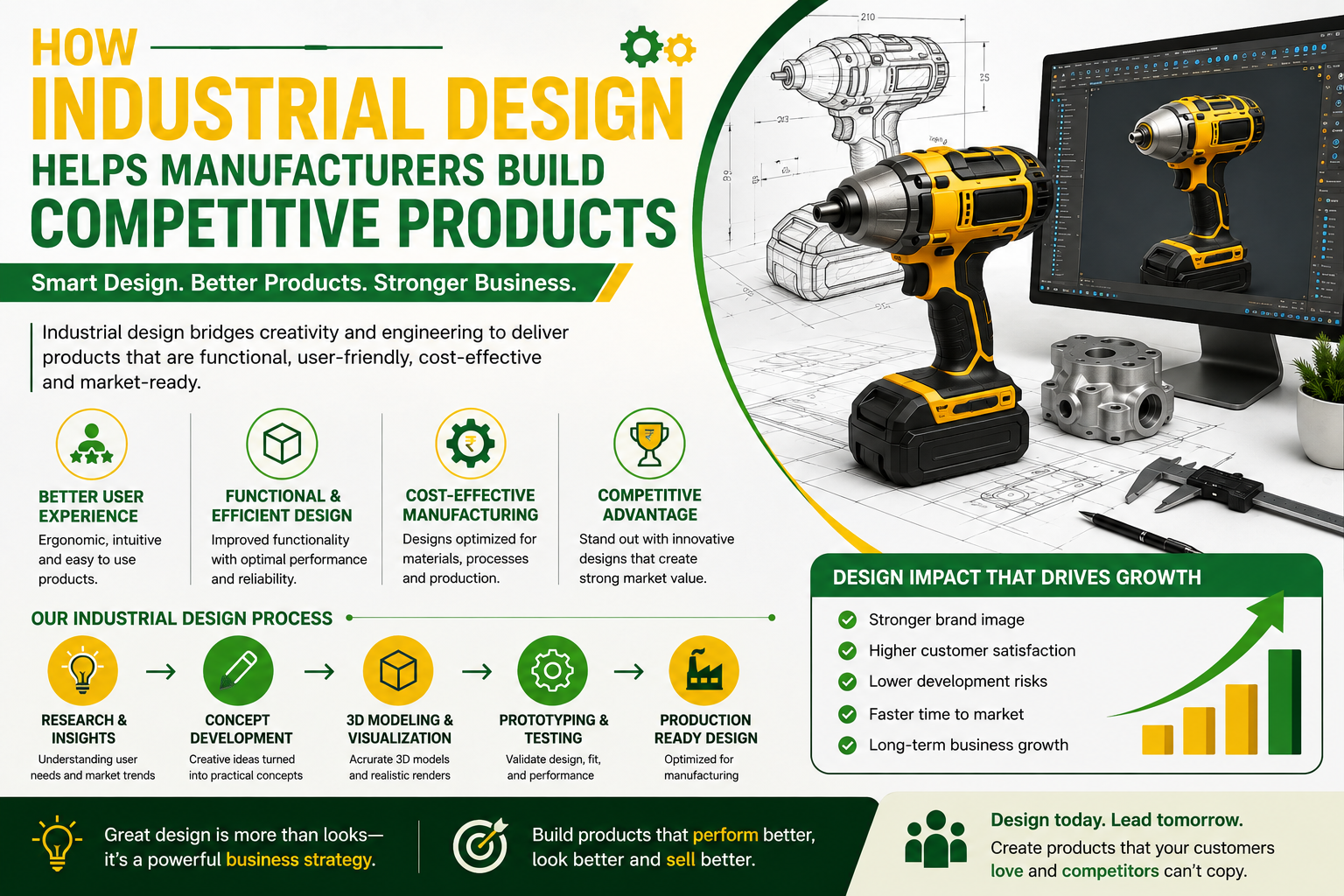
Prototyping is an important stage of product development. A prototype allows manufacturers and designers to evaluate a product before moving into full-scale production.
Physical prototypes can be tested for dimensions, usability, ergonomics, assembly, strength, and appearance. Digital prototypes and 3D visualization can also help teams identify design problems and communicate concepts to stakeholders.
Professional Industrial Product Design Services can integrate concept development, 3D modeling, prototyping, testing, and design refinement into a structured workflow.
Building Product Differentiation
Competition often comes down to small but meaningful differences. A product may stand out because it is easier to use, lighter, more compact, more attractive, easier to maintain, or better suited to a specific application.
Industrial Product Design Services helps manufacturers identify these opportunities. Designers can explore multiple concepts before selecting the solution that offers the strongest balance between customer value and manufacturing feasibility.
This approach allows businesses to move beyond price-based competition and develop products with distinctive value propositions.
Adapting to Market Trends
Markets continuously change due to new technologies, customer expectations, sustainability requirements, and production methods. Manufacturers need designs that can adapt to these changes.
Industrial designers can help businesses explore modern materials, compact form factors, modular structures, sustainable design approaches, and improved user interfaces. These developments can help products remain relevant for longer periods.
Reducing Development Risks
Product development involves investment in engineering, materials, tooling, testing, and manufacturing. Design errors discovered late in the process can become expensive to correct.
Early concept evaluation, CAD modeling, prototyping, and user testing can reduce these risks. Industrial Product Design Services provide manufacturers with structured design support that helps identify potential issues before they affect production.
Conclusion
Industrial design has become a strategic advantage for manufacturers looking to compete in demanding markets. It connects customer expectations with functionality, aesthetics, usability, engineering, and manufacturing requirements. By investing in professional design, businesses can improve product quality, reduce development risks, strengthen differentiation, and create better customer experiences.
My Design Minds helps manufacturers turn product ideas into practical, market-ready solutions through professional industrial design and product development expertise. The team supports concept development, 3D CAD modeling, product visualization, prototyping, design refinement, and manufacturing-focused development. My Design Minds focuses on balancing aesthetics, functionality, ergonomics, engineering requirements, and production feasibility. Whether a business is developing a new product or improving an existing one, its design support can help create efficient and competitive solutions. With a focus on innovation and manufacturability, My Design Minds helps manufacturers transform concepts into products that are designed for real-world use, scalable production, and long-term market success.
My Design Minds delivers professional Industrial Product Design Services, industrial design solutions, product development services, and manufacturing product design to help manufacturers create innovative, functional, cost-effective, and market-ready products.