Every successful product begins with an idea, but an idea alone is not enough to create a market-ready product. A concept must be evaluated, refined, tested, and transformed into a design that can be manufactured efficiently and consistently. This is where Product Concept Development plays an important role.
From understanding customer requirements to developing prototypes and selecting suitable materials, concept development creates a structured path between an initial idea and a functional product. It helps businesses reduce design risks, control development costs, and improve product performance before large-scale manufacturing begins.
What Is Concept Development?
Concept development is the process of turning an initial product idea into a detailed and practical design concept. It involves understanding the intended application, target users, technical requirements, manufacturing limitations, materials, aesthetics, and expected performance.
A strong concept considers not only how a product should look but also how it will function, how it will be assembled, what materials should be used, and how it can be manufactured at the required volume.
This early-stage planning helps identify potential problems before they become expensive manufacturing issues.
From Idea to Practical Product Design and Development
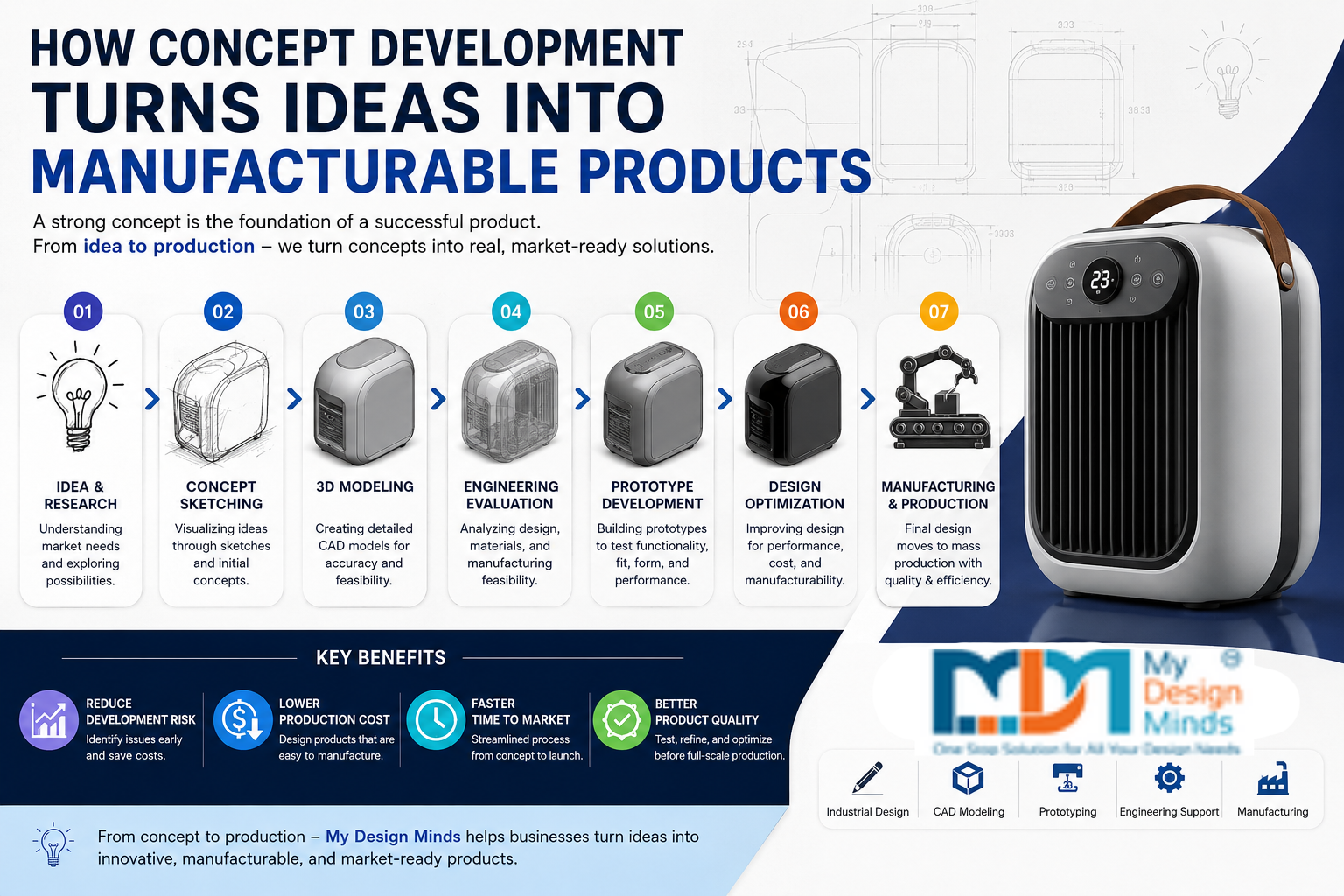
The journey from an idea to a manufacturable product design generally involves several important stages.
1. Understanding the Product Requirement
The first step is clearly defining what the product needs to achieve. Designers and engineers study the target market, customer expectations, product applications, dimensions, performance requirements, and environmental conditions.
For example, a component intended for automotive use may need to withstand vibration, heat, pressure, and repeated mechanical loads. These requirements influence the design from the beginning.
A clearly defined product brief gives the development team a foundation for making technical and design decisions.
2. Research and Idea Evaluation
Not every idea is immediately suitable for production. Research helps determine whether the proposed concept is technically and commercially viable.
The team may evaluate existing products, competing solutions, available technologies, customer expectations, and manufacturing methods. This stage can also reveal opportunities to improve functionality, reduce material usage, or simplify assembly.
Evaluating different ideas early prevents businesses from investing heavily in concepts that may not be practical.
3. Creating the Product Concept Development
Once requirements are understood, designers develop initial concepts. Sketches, mood boards, layouts, and preliminary 3D models can be used to visualize different possibilities.
Several concepts may be compared based on functionality, appearance, ergonomics, cost, materials, and manufacturability.
This is an important part of Product Concept Development because design decisions made at this stage can significantly influence the final manufacturing process.
4. 3D Modeling and Engineering Design
After selecting a promising concept, it can be developed into a detailed 3D CAD model. CAD allows designers and engineers to define dimensions, features, interfaces, wall thicknesses, mounting points, and other technical details.
Digital models also make it easier to identify design conflicts and make modifications before physical prototypes are produced.
For complex industrial products, CAD-based development provides a strong foundation for engineering analysis and manufacturing documentation.
5. Designing for Manufacturing
A product may look excellent on screen but still be difficult or expensive to manufacture. Design for Manufacturing (DFM) ensures that the product concept development is compatible with the selected production method.
Manufacturing considerations may include:
- Material selection
- Wall thickness
- Draft angles
- Tolerances
- Part geometry
- Assembly requirements
- Tooling limitations
- Production volume
- Surface finishing
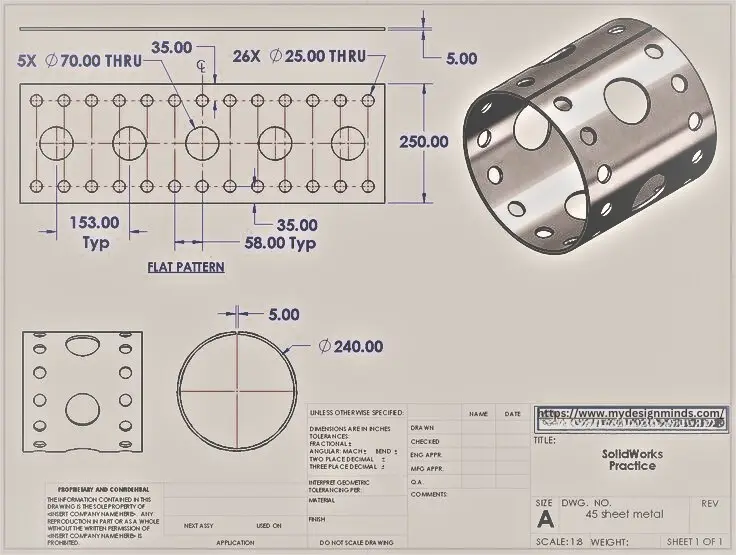
For example, an injection-moulded component may require appropriate draft angles and uniform wall thickness to avoid defects. A sheet metal component may need suitable bend radii and allowances.
Considering these factors during Product Concept Development can reduce redesigns and production delays.
6. Prototype Development and Testing
Prototyping converts the digital concept into a physical representation. Depending on the product, prototypes may be produced using 3D printing, CNC machining, vacuum casting, or other rapid manufacturing techniques.
A prototype allows teams to evaluate dimensions, ergonomics, appearance, assembly, functionality, and usability.
Testing can reveal issues that may not be obvious in a CAD model. The design can then be modified and another prototype created until the desired performance is achieved.
7. Design Optimization
After testing, engineers refine the product based on the results. Optimization may involve reducing unnecessary material, improving strength, simplifying components, reducing assembly steps, or improving the product’s appearance.
Simulation and engineering analysis can also help evaluate structural performance, thermal behavior, airflow, or other product-specific requirements.
The objective is to create a balanced design that meets performance requirements while remaining practical and cost-effective to manufacture.
Benefits of Professional Product Development Process
A structured product concept development process provides several advantages for businesses.
Reduced development risk: Potential design and manufacturing problems can be identified earlier.
Lower production costs: Optimizing the design before tooling and mass production can reduce expensive modifications.
Faster time to market: A structured workflow helps move efficiently from concept to prototype and production.
Better product quality: Testing and refinement improve reliability and functionality.
Improved manufacturability: Manufacturing requirements are considered from the early design stages rather than after the product is finalized.
Turning Innovation into Production
Successful products require collaboration between designers, engineers, manufacturers, and business teams. A concept should balance creativity with technical feasibility, production requirements, customer expectations, and commercial objectives.
Professional product development services help businesses manage this process systematically. Instead of moving directly from an idea to manufacturing, companies can validate their concepts, identify risks, build prototypes, and optimize designs before committing to production tooling and large quantities.
Conclusion
Transforming an idea into a manufacturable product design requires much more than creating an attractive design. It requires research, engineering, CAD development, prototyping, testing, optimization, and careful consideration of manufacturing requirements. Product Concept Development connects these stages and creates a clear pathway from an early idea to a production-ready solution.
For businesses looking to develop reliable and commercially viable products, working with an experienced design and engineering partner can make the development process more efficient. My Design Minds supports businesses with industrial design, CAD modeling, prototyping, and product development services to help transform product ideas into practical solutions. From initial concept development to manufacturing-ready designs, My Design Minds focuses on functionality, manufacturability, quality, and customer requirements. With the right development approach, businesses can reduce design risks, accelerate product development, and move confidently from concept to production.