Designing an industrial product is not only about appearance, performance, or manufacturing efficiency. A successful product must also be comfortable, safe, intuitive, and easy to use. This is where Product Ergonomic Design becomes important. By considering how people interact with tools, machines, equipment, and everyday industrial products, designers can create solutions that improve usability while reducing physical strain.
What Is Product Ergonomic Design?
Product ergonomics focuses on designing products around human abilities, limitations, movements, and needs. It considers factors such as posture, grip, reach, force, body dimensions, visibility, control placement, and repetitive movements.
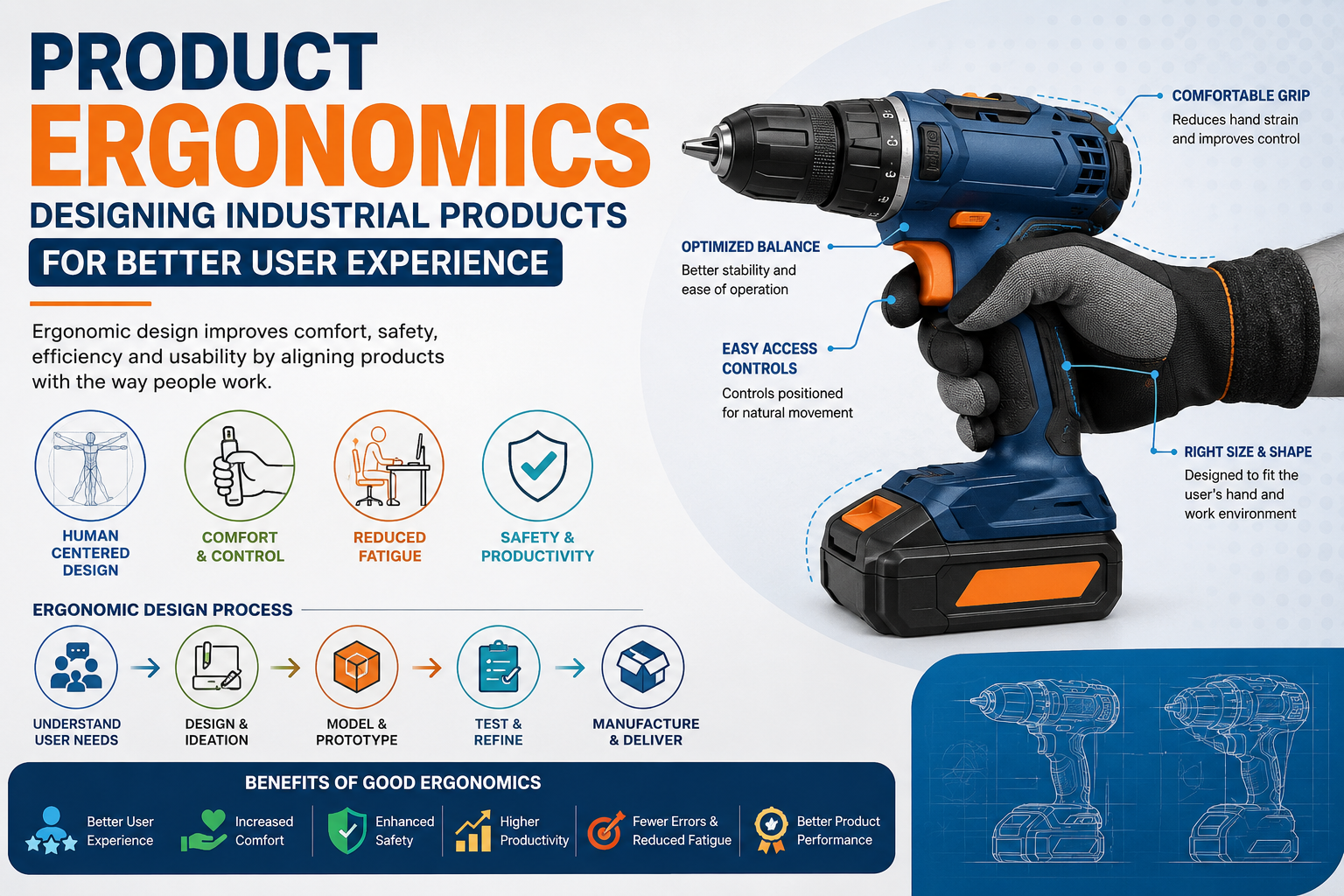
A well-designed product allows users to operate it naturally without unnecessary effort. For example, a handheld tool should have a comfortable grip, appropriate weight distribution, and controls positioned where users can easily access them. Similarly, industrial machinery should provide clear interfaces and accessible operating areas.
Why Ergonomics Matters in Industrial Product Design
Poor ergonomics can lead to discomfort, fatigue, operational errors, and reduced productivity. When workers repeatedly use products that are difficult to handle, the risk of strain and mistakes can increase.
Effective ergonomic product design addresses these challenges at the development stage. Designers can study user requirements, evaluate different concepts, and create prototypes to understand how a product performs in real-world situations.
Ergonomics can also improve customer satisfaction. Products that feel comfortable and intuitive are easier to learn and operate. This can create a better overall experience and strengthen the perceived quality of a product.
Key Elements of Ergonomic Product Design
Several factors influence successful industrial product ergonomics:
1. Human Dimensions
Designers consider body measurements and physical capabilities when determining product dimensions. This helps ensure that products can be used comfortably by the intended audience.
2. Comfort and Grip
Handles, controls, and contact surfaces should support natural hand positions. Proper grip design can reduce unnecessary pressure and improve handling.
3. Weight and Balance
A product that is too heavy or poorly balanced can become difficult to operate. Designers can distribute weight appropriately to improve control and reduce fatigue.
4. Accessibility
Buttons, switches, displays, and adjustment mechanisms should be easy to reach and understand. Clear positioning can make operation faster and more intuitive.
5. Safety
Ergonomics and safety often work together. Designers can reduce awkward movements, improve visibility, and position controls to minimize operational risks.
Using Prototyping to Improve Ergonomics
Prototyping provides an opportunity to evaluate ergonomics before mass production. Physical or digital prototypes can help designers assess dimensions, grip positions, control layouts, visibility, and user interaction.
Testing prototypes with representative users can reveal problems that may not be obvious during the initial design process. Designers can then make adjustments before tooling and manufacturing begin. This approach can save development costs while improving the final product.
Role of User-Centered Design
User-centered product design places the intended user at the center of the development process. Instead of designing only around technical specifications, teams consider how customers will actually interact with the product.
User feedback can influence everything from the shape of a handle to the placement of controls and the size of an interface. Combining user research with engineering requirements can create products that balance functionality, appearance, manufacturability, and comfort.
Ergonomics and Manufacturing Efficiency
Ergonomic considerations should be introduced early rather than added after the product has been finalized. Early integration allows designers to evaluate materials, components, dimensions, assembly requirements, and manufacturing processes together.
For manufacturers, better industrial product ergonomics can also support easier maintenance and handling. Products designed with accessibility in mind can make inspection, servicing, and component replacement more efficient.
Benefits of Better Product Ergonomics
A strong ergonomic approach can provide several benefits:
- Improved user comfort and satisfaction
- Reduced physical strain
- Easier product operation
- Better productivity
- Fewer user errors
- Improved safety
- Stronger product usability
- Better customer perception
- More effective product differentiation
Conclusion
Ergonomics is an essential part of modern industrial product development. By understanding users and considering comfort, safety, accessibility, movement, and usability, designers can create products that perform effectively in real-world environments. Product Ergonomic Design helps businesses move beyond basic functionality and develop products that are practical, intuitive, and human-focused.
My Design Minds supports businesses with professional industrial design and product development solutions focused on usability, functionality, and manufacturability. From concept development and 3D modeling to prototyping and production-ready design, My Design Minds helps companies create practical industrial products. Its design approach considers user requirements, product functionality, aesthetics, ergonomics, and manufacturing needs. By combining creative thinking with engineering expertise, My Design Minds helps businesses transform ideas into market-ready products designed for better user experiences and efficient manufacturing.