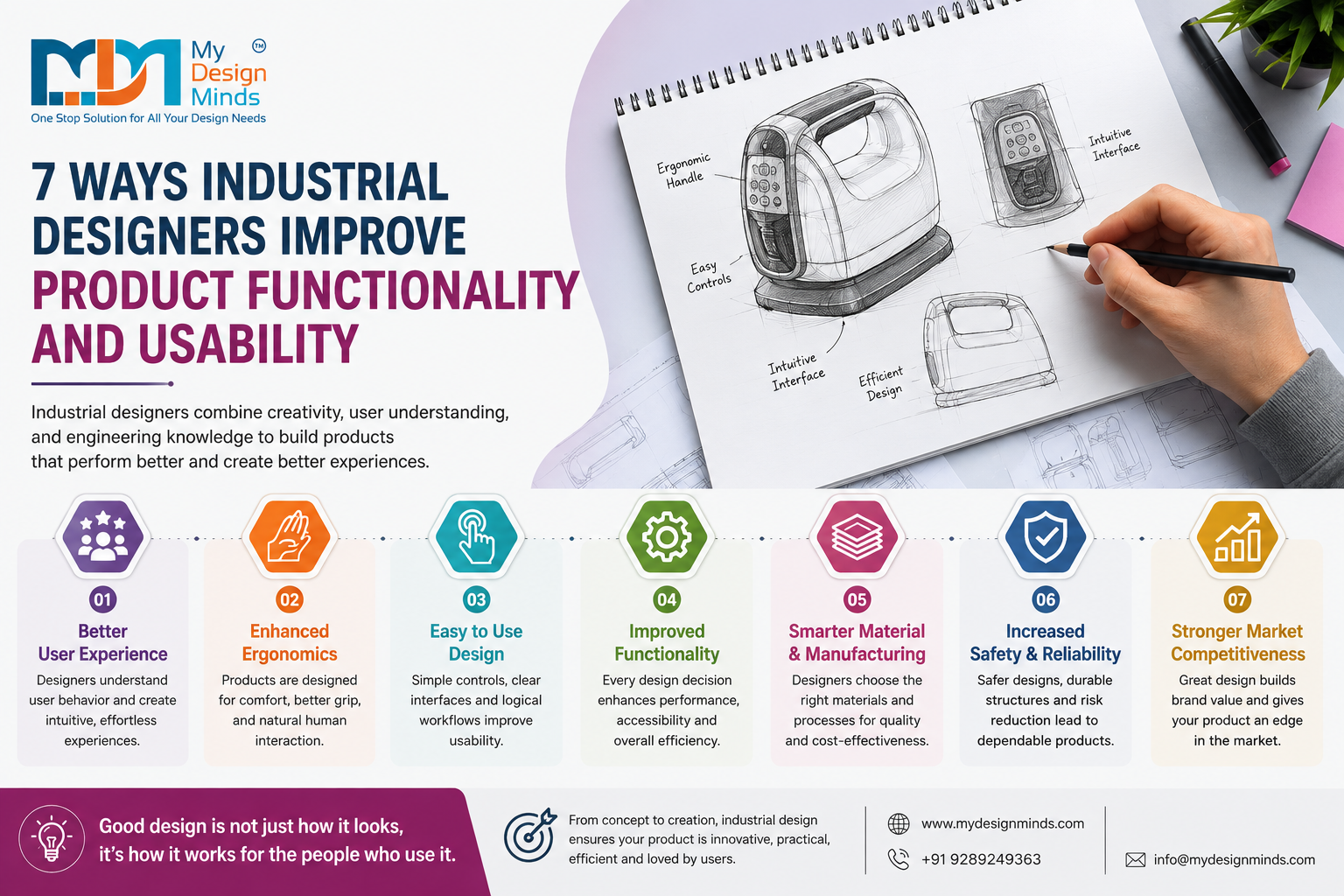
A successful product is more than an attractive shape. Customers expect products to be comfortable, simple to operate, reliable, safe, and efficient. This is where industrial designers play an important role. They combine creativity, engineering awareness, user research, and manufacturing knowledge to turn product concepts into practical solutions.
Professional Industrial Design Services help businesses identify usability problems and create products that perform effectively in real-world conditions. From consumer products and electronics to industrial equipment and automotive components, industrial designers focus on how people interact with products and how the product can deliver a better overall experience.
1. Improve User Experience
One of the primary responsibilities of an industrial designer is understanding how users interact with a product. Designers consider factors such as hand position, operating sequence, visibility, accessibility, controls, and feedback.
A product may have advanced technology, but if users find it confusing or uncomfortable, its market potential can suffer. Industrial designers simplify interactions by arranging controls logically, improving product proportions, and creating intuitive operating processes.
User-focused Product Design Services can therefore help businesses create products that are easier to understand and more enjoyable to use.
2. Enhance Ergonomics and Comfort
Ergonomics directly affects product usability. Products that are uncomfortable to hold, operate, carry, or maintain may lead to customer dissatisfaction.
Industrial designers evaluate how the human body interacts with a product. They may analyse grip dimensions, button placement, viewing angles, operating force, weight distribution, and posture requirements.
For example, a handheld device can be redesigned with a more comfortable grip, while industrial equipment can be adjusted to make frequently used controls easier to access.
By considering human factors during the design stage, businesses can develop products that reduce unnecessary effort and improve everyday usability.
3. Make Products Easier to Use
Good industrial design removes unnecessary complexity. A product should communicate its purpose clearly without requiring users to spend excessive time learning how it works.
Designers can improve usability through clear controls, visual indicators, intuitive interfaces, logical component placement, and simplified assembly or operation.
This becomes particularly important for products used by people with different levels of technical knowledge. A well-designed product should guide users naturally through important functions.
Industrial designers may also create prototypes and conduct usability evaluations to identify confusing areas before the product reaches the market.
4. Improve Product Functionality
A visually attractive product is not successful if its functionality does not meet customer expectations. Industrial designers work closely with engineering teams to ensure that appearance and performance support each other.
During development, designers can identify opportunities to improve storage, accessibility, maintenance, portability, adjustability, and component integration.
Modern Industrial Design Services can help businesses balance aesthetics with functional requirements. Instead of adding unnecessary design elements, designers focus on features that provide genuine value to users.
This approach can result in products that are easier to operate while also supporting practical manufacturing requirements.
5. Support Better Material and Manufacturing Decisions
Industrial design also influences material selection and manufacturing methods. A product’s appearance, weight, durability, surface finish, and cost can depend heavily on these decisions.
Designers consider whether a component is suitable for injection moulding, sheet metal fabrication, CNC machining, 3D printing, casting, or another production method.
Early collaboration between designers and manufacturers can help identify potential production issues before tooling or mass manufacturing begins. It can also prevent costly redesigns later in the development cycle.
The result is a product that is not only attractive and functional but also realistic to manufacture at the required production volume.
6. Increase Safety and Reliability
Safety is another important consideration in product development. Industrial designers can identify situations where incorrect use, sharp edges, poor grip, excessive operating force, or difficult access could create problems.
Designers can introduce rounded edges, protective housings, improved grips, visual warnings, controlled access, and other features that support safer operation.
Reliability can also be improved by considering how the product will be handled, transported, assembled, cleaned, and maintained.
These considerations are especially important for industrial equipment, tools, medical-related products, appliances, and products used in demanding environments.
7. Strengthen Product Appeal and Market Competitiveness
Functionality and usability are important, but customers also respond to appearance. Industrial designers help businesses create a visual identity that communicates product quality and differentiates a product from competitors.
Shape, proportion, colour, texture, surface finish, and component integration can influence how customers perceive a product.
A strong design can make a product appear easier to use, more reliable, more premium, or more innovative. When functional improvements are combined with appealing aesthetics, businesses can create stronger products with greater market potential.
Professional Product Design Services can help companies evaluate these elements before finalising the product.
Why Industrial Design Matters in Product Development
Industrial design should not be treated as a final styling activity. It should be integrated into product development from the beginning. Early design involvement allows companies to identify usability challenges, improve ergonomics, explore manufacturing options, and validate concepts before significant production investment.
For businesses seeking an experienced Industrial Design Company, it is important to evaluate design expertise, engineering capabilities, prototyping experience, manufacturing knowledge, and understanding of the target customer.
A structured industrial design process can help transform an initial concept into a product that is functional, comfortable, attractive, manufacturable, and commercially competitive.
Industrial Design Solutions by My Design Minds
My Design Minds provides integrated industrial design, product design, CAD, prototyping, and manufacturing support for businesses developing new products. Our team focuses on functionality, usability, ergonomics, aesthetics, and manufacturing feasibility throughout the development process. From early concepts and 3D CAD models to prototypes and production-ready designs, My Design Minds helps businesses turn ideas into practical products. By combining design thinking with engineering and manufacturing knowledge, we help companies improve product performance, simplify user interaction, reduce development challenges, and build solutions ready for the market. Our approach is focused on creating efficient, user-friendly, and commercially valuable products for Indian and global businesses.