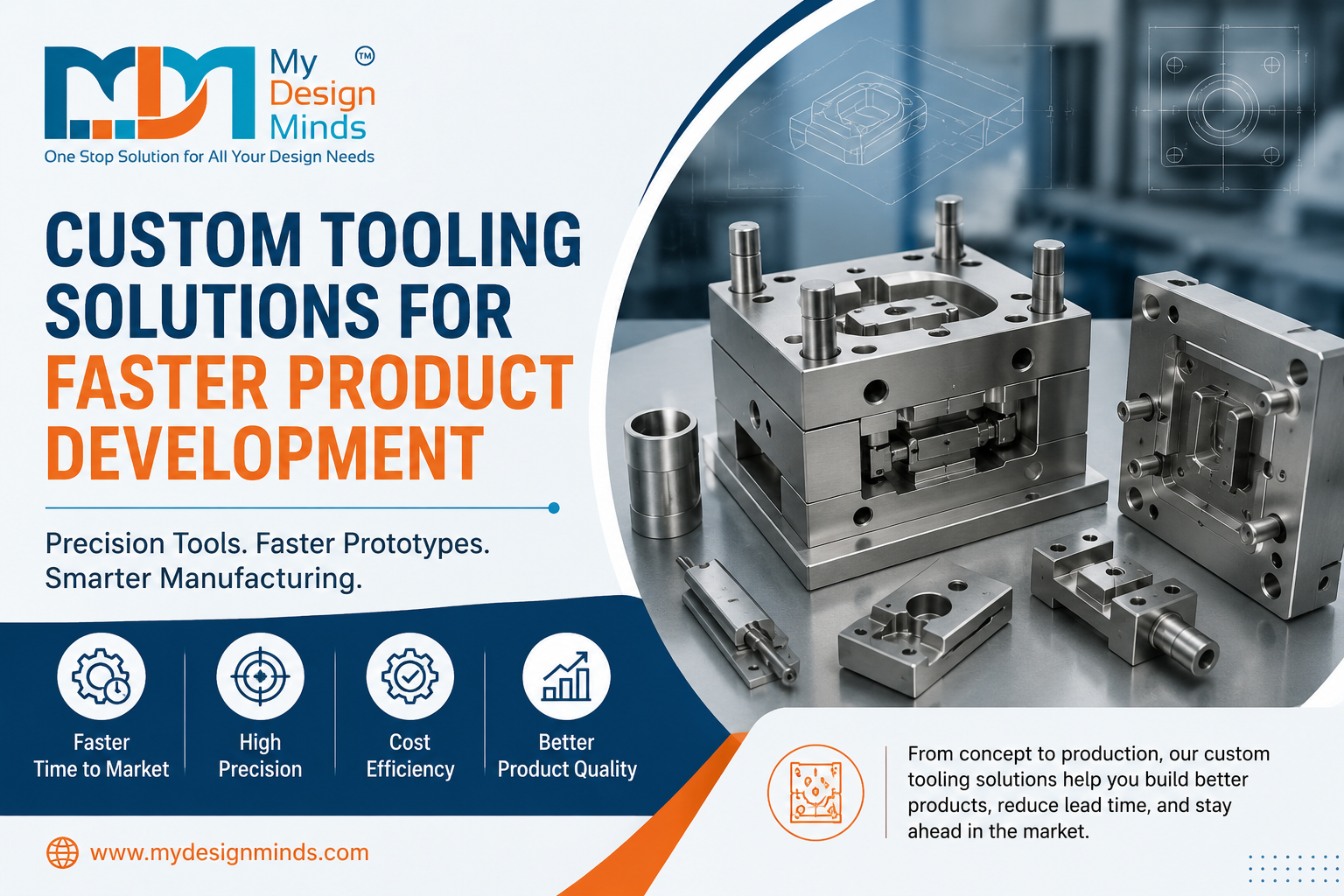
In modern manufacturing, speed can make the difference between a successful product launch and a missed market opportunity. Companies need to move quickly from concept and CAD design to prototypes, testing, validation, and production. One of the most important elements influencing this journey is tooling. Well-designed tooling can improve manufacturing consistency, reduce repeated adjustments, and support faster product development cycles.
For manufacturers, startups, OEMs, and engineering companies, Tooling Manufacturing India can provide a practical approach to developing precision tools while balancing quality, cost, and production timelines. Custom tooling can be designed around a specific component, material, manufacturing process, and expected production volume rather than relying on a standard solution.
What Are Custom Tooling Solutions?
Custom tooling refers to specially engineered tools, dies, moulds, jigs, fixtures, gauges, and other manufacturing aids developed for a particular product or production requirement. These solutions help manufacturers achieve repeatable dimensions, better process control, and efficient production.
Depending on the application, tooling may include injection moulds, sheet metal dies, press tools, casting dies, machining fixtures, assembly fixtures, and inspection gauges. Modern tooling providers can also support prototype and low-volume requirements before companies invest in full-scale production tooling.
The advantage of custom tooling is that it considers the actual product geometry and manufacturing process. Engineers can evaluate factors such as tolerances, material behaviour, parting lines, machining requirements, cycle time, and assembly needs during the development stage.
How Custom Tooling Speeds Up Product Development
1. Faster Prototype Validation
A product cannot be successfully launched based only on a digital model. Physical prototypes are often required to evaluate dimensions, fit, functionality, appearance, and manufacturability.
Prototype tooling India solutions can help companies produce functional parts for testing and validation before committing to high-volume production. Soft tooling, aluminium tooling, and other low-volume approaches can be suitable when design changes are still expected.
This allows engineering teams to identify problems earlier and make necessary modifications before expensive production tooling is finalised.
2. Reduced Design Iterations
Tooling problems discovered late in the development process can result in costly modifications and production delays. A strong tooling development process begins with design evaluation and manufacturability analysis.
Using tool design services India, manufacturers can review component geometry, tolerances, material selection, ejection requirements, cooling, forming operations, and other production considerations before tool manufacturing begins.
Early engineering feedback can reduce the number of physical iterations required and create a smoother transition from CAD to production.
3. Better Manufacturing Consistency
Precision tooling provides controlled and repeatable manufacturing conditions. Fixtures can help position components accurately, while dies and moulds can maintain consistent geometry across production cycles.
Government-supported manufacturing guidance also highlights the importance of precision tooling in reducing waste, improving productivity, controlling costs, and maintaining consistent quality.
For companies producing thousands of components, even a small improvement in repeatability can have a significant impact on overall manufacturing efficiency.
Custom Tooling for Different Production Stages
Every product does not require the same type of tooling. A new product may begin with prototype tooling and later move toward production-grade moulds or dies.
For example, a company testing a new plastic component may initially use a single-cavity or soft tool for functional validation. After the design is approved and production volumes increase, the manufacturer can transition to a multi-cavity production mould.
Similarly, sheet metal products may require prototype dies during development before moving to progressive or high-volume production tooling.
This staged approach helps companies avoid investing heavily in production tooling before the product has been properly validated.
Cost Advantages of the Right Tooling Strategy
Tooling is an investment, but the right strategy can reduce manufacturing costs over the complete product lifecycle. Efficient tooling can reduce manual operations, improve production speed, minimise material waste, and increase part consistency.
Custom tooling can also be designed around expected production volume. Short-run or prototype tools may be more appropriate for market testing, while hardened production tools may be justified when demand increases.
This is particularly important for startups and growing manufacturers that need to control upfront investment while maintaining development speed.
Why Choose Tooling Manufacturing India?
India has developed a growing ecosystem of engineering, tooling, machining, mould manufacturing, and product development capabilities. Manufacturers can combine CAD engineering, CNC machining, prototyping, tooling, and production support through integrated supply chains.
For international OEMs and Indian manufacturers, Tooling Manufacturing India can therefore be considered when looking for a balance between engineering capability, manufacturing flexibility, and cost efficiency.
A reliable tooling partner should have experience in CAD/CAM, CNC machining, precision inspection, material selection, tool modification, and prototype development. Strong communication between the design and tooling teams is equally important because product changes can occur throughout development.
Choosing the Right Custom Tooling Partner
Before selecting a tooling manufacturer, companies should evaluate several factors:
- Experience with similar products and materials
- CAD/CAM and engineering capabilities
- CNC machining and precision manufacturing facilities
- Prototype and low-volume tooling capability
- Quality inspection processes
- Ability to accommodate design modifications
- Expected tool life and production volume
- Project timeline and communication process
- Post-development tooling support
A supplier that understands both product design and manufacturing can identify potential problems earlier than a supplier focused only on tool fabrication.
The Role of Tooling in Faster Product Launches
Product development is becoming increasingly competitive. Companies cannot afford unnecessary delays between design approval, prototype testing, tooling, and production. Custom tooling provides the manufacturing foundation needed to transform a validated design into repeatable physical components.
With prototype tooling India, businesses can validate products earlier. With tool design services India, engineering teams can improve manufacturability before fabrication. Together, these approaches can create a more efficient path from concept to production.
For businesses seeking Tooling Manufacturing India, the objective should not simply be to find the lowest tooling price. The better approach is to evaluate engineering expertise, quality, flexibility, lead time, tool life, and long-term manufacturing support.
Custom Tooling Solutions by My Design Minds
My Design Minds supports businesses looking for practical and engineering-focused product development and manufacturing solutions. Our approach connects product design, CAD engineering, prototyping, tooling, and manufacturing requirements to help businesses move efficiently from concept toward production.
For companies developing new industrial products, consumer products, automotive components, or engineered parts, the right tooling strategy can reduce development bottlenecks and improve production readiness. My Design Minds focuses on customised engineering solutions based on product requirements, material, production volume, and application. By combining design understanding with manufacturing knowledge, we help businesses make better tooling decisions and move their products closer to market with greater confidence.