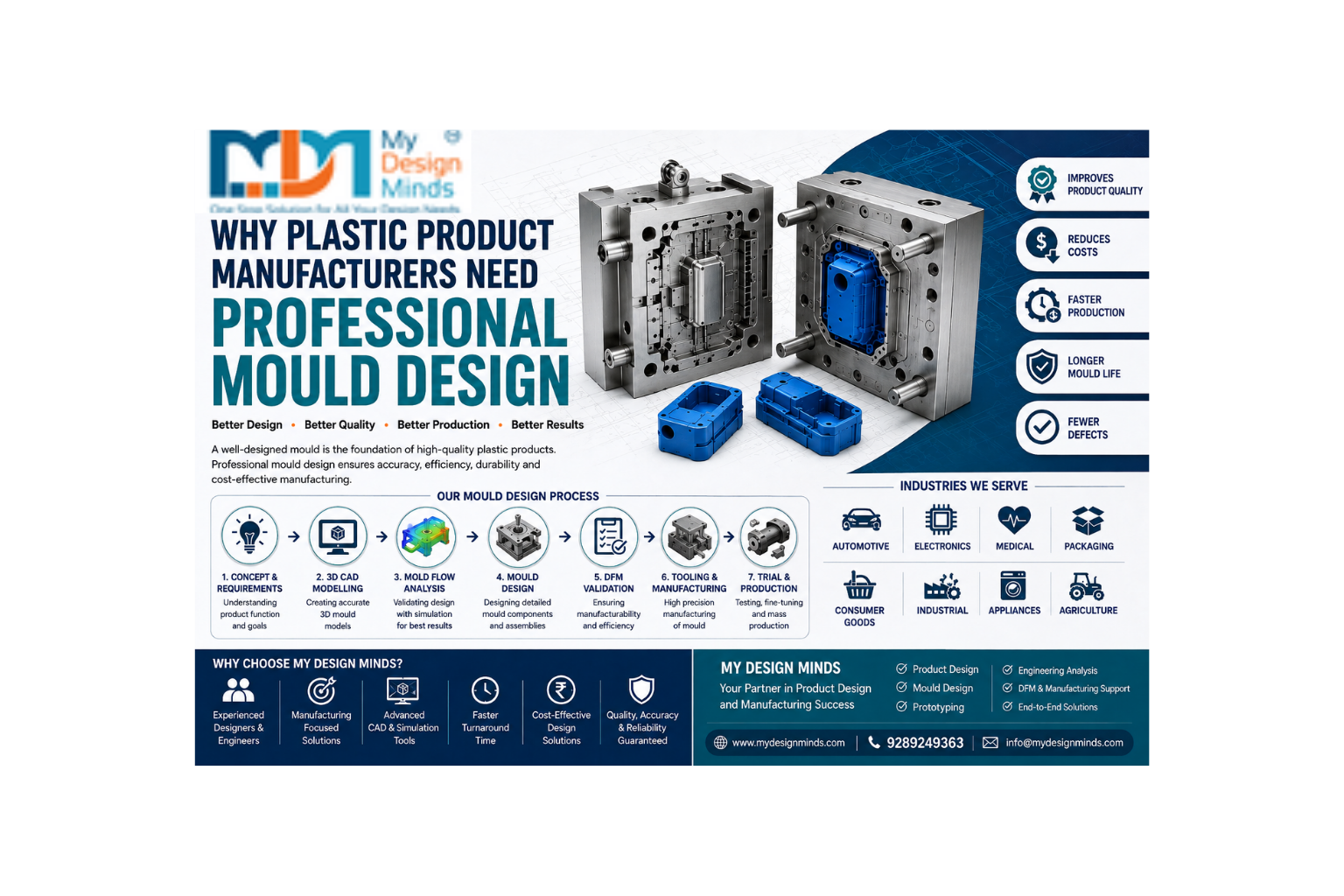
Professional Mould Design is one of the most important factors in achieving consistent quality, efficient production, and cost-effective plastic product manufacturing. While the mould may appear to be only a tooling component, its design directly affects product dimensions, surface finish, cycle time, material consumption, production efficiency, and overall mould life.
For manufacturers producing automotive components, electrical parts, consumer products, medical devices, packaging, and industrial components, professionally engineered moulds can reduce manufacturing risks and improve production performance. A poorly designed mould can result in defects, excessive maintenance, longer production cycles, and expensive modifications.
At My Design Minds, we provide advanced Mould Design Services that help manufacturers develop accurate, durable, and production-ready tooling solutions. Our engineering approach combines CAD modelling, DFM principles, mould optimization, and manufacturing expertise to deliver reliable results.
What Is Professional Mould Design?
Professional mould design involves developing the complete tooling structure required to manufacture plastic components accurately and repeatedly. Engineers consider product geometry, material properties, shrinkage, draft angles, parting lines, cooling systems, runners, gates, ejectors, and manufacturing requirements.
Using advanced CAD software and engineering methods, designers can identify potential issues before mould manufacturing begins. This reduces development risks and helps manufacturers achieve better production results.
1. Improves Plastic Product Quality
One of the biggest advantages of Professional Mould Design is improved product consistency. Accurate tooling ensures that every plastic component is produced according to the required dimensions and specifications.
Proper mould design helps control:
- Dimensional accuracy
- Wall thickness
- Surface finish
- Shrinkage
- Warpage
- Flash
- Sink marks
Better tooling accuracy ultimately results in higher-quality finished products.
2. Reduces Manufacturing Costs
Professional Mould Design Services can help manufacturers control tooling and production costs. Engineers optimize mould construction, material usage, cooling systems, and manufacturing processes to avoid unnecessary expenses.
A well-designed mould can reduce:
- Material waste
- Rework
- Production defects
- Maintenance costs
- Machine downtime
- Tool modification expenses
Early design validation is particularly valuable because correcting a mould after manufacturing can be expensive and time-consuming.
3. Increases Production Efficiency
Production efficiency depends heavily on mould performance. An optimized cooling system can reduce cycle time and allow manufacturers to produce more components within the same production period.
Efficient mould design considers:
- Cooling channel layout
- Runner configuration
- Gate location
- Ejection system
- Cavity arrangement
These factors contribute to faster and more consistent production.
4. Supports Complex Plastic Components
Modern plastic products often feature complicated shapes, ribs, bosses, snap-fits, undercuts, and intricate surface details.
Advanced Injection Mould Design allows engineers to accommodate these features while maintaining manufacturability. Proper tooling strategies can help produce complex components without unnecessary secondary operations.
5. Minimizes Production Defects
Mould-related problems can create significant production challenges. Professional design and engineering validation help identify potential defects before manufacturing begins.
Common defects include:
- Warpage
- Short shots
- Flash
- Sink marks
- Weld lines
- Air traps
- Uneven filling
Addressing these issues during the design stage reduces production risks and improves product reliability.
6. Extends Mould Life
A professionally designed mould can provide reliable service over many production cycles. Engineers select suitable mould materials and design components to withstand repeated mechanical, thermal, and pressure-related stresses.
Proper design of cooling systems, moving components, ejectors, and guide mechanisms can also reduce wear and maintenance requirements.
7. Improves Cooling Performance
Cooling is a critical part of Plastic Product Manufacturing because it directly affects cycle time, dimensional stability, and product quality.
An optimized cooling system helps achieve:
- Faster cooling
- Consistent shrinkage
- Reduced warpage
- Shorter cycle times
- Improved dimensional stability
Proper cooling design can therefore have a significant impact on overall production efficiency.
8. Supports Design for Manufacturing
Design for Manufacturing (DFM) should be considered before mould development begins. DFM helps engineers identify design features that may increase tooling complexity or production costs.
At My Design Minds, DFM principles help manufacturers simplify product geometry, optimize wall thickness, improve draft angles, and select appropriate manufacturing methods.
9. Enables Better Material Utilization
Mould geometry, gate placement, runner design, and cavity configuration influence material flow and consumption. Optimizing these elements can minimize unnecessary material usage.
Efficient material utilization helps manufacturers reduce costs while supporting more sustainable production practices.
Industries That Benefit from Professional Mould Design
Professional mould development is widely used across multiple industries, including:
- Automotive
- Consumer Electronics
- Medical Devices
- Electrical Equipment
- Packaging
- Industrial Machinery
- Household Products
- Agricultural Equipment
- Consumer Goods
- Renewable Energy
Each application requires moulds designed around specific product, material, and production requirements.
How My Design Minds Supports Mould Design
At My Design Minds, we provide comprehensive Mould Design Services for businesses developing and manufacturing plastic products. Our engineering capabilities include:
- Injection Mould Design
- 3D CAD Modelling
- Product Design
- DFM Analysis
- Mould Optimization
- Reverse Engineering
- Prototype Development
- Tooling Support
- Manufacturing Support
Our team works closely with clients to understand product requirements and develop tooling solutions optimized for quality, efficiency, and manufacturability.
Why Choose My Design Minds?
Businesses can benefit from our:
- Experienced engineering professionals
- Advanced CAD capabilities
- Manufacturing-focused design approach
- Customized mould solutions
- Cost-effective engineering support
- Production-ready documentation
- End-to-end product development expertise
By combining design and manufacturing knowledge, we help businesses minimize tooling risks and achieve more efficient production.
Conclusion
Professional Mould Design plays a crucial role in successful plastic product manufacturing. From improving dimensional accuracy and surface quality to reducing cycle times, production defects, and maintenance costs, a well-engineered mould provides significant long-term benefits.
At My Design Minds, our Mould Design Services help manufacturers develop accurate, durable, and production-ready tooling for a wide range of plastic applications. Through advanced CAD modelling, DFM analysis, mould optimization, and engineering expertise, we help businesses improve product quality, control costs, and accelerate production.
Whether you are developing a new plastic product or improving an existing component, professional Injection Mould Design can provide the engineering foundation needed for efficient, reliable, and scalable manufacturing.