
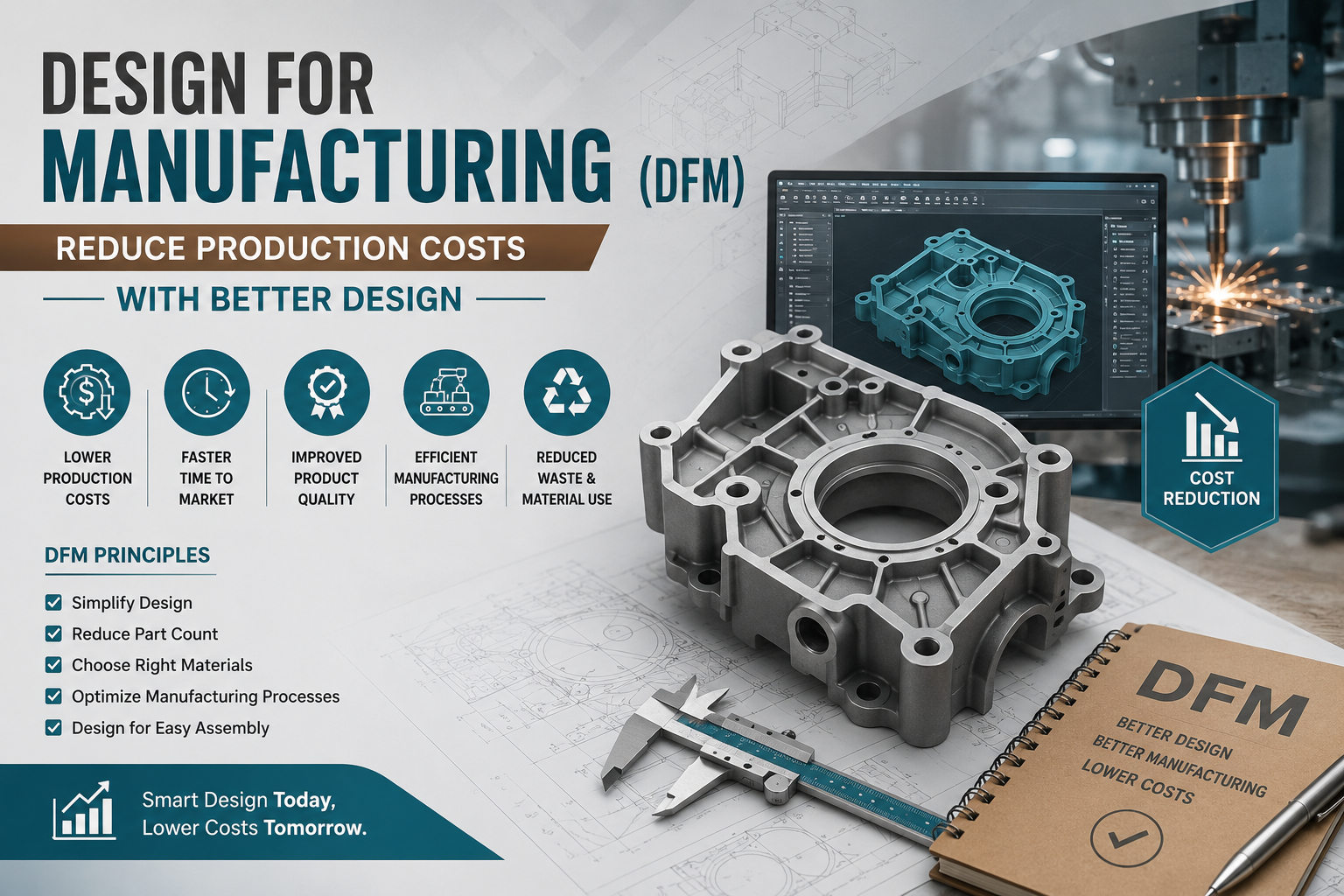
In today’s highly competitive manufacturing industry, businesses must balance quality, cost, and speed to remain successful. One of the most effective ways to achieve this balance is through Design for Manufacturing (DFM). By considering manufacturing processes during the product design stage, companies can reduce production costs, improve product quality, and accelerate time-to-market.
Whether you’re developing consumer products, automotive components, industrial equipment, or medical devices, implementing Design for Manufacturing (DFM) helps eliminate costly design errors before production begins. This proactive approach enables manufacturers to produce reliable products with fewer modifications, reduced waste, and greater efficiency.
What is Design for Manufacturing (DFM)?
Design for Manufacturing (DFM) is an engineering methodology that focuses on designing products that are easy, cost-effective, and efficient to manufacture. Instead of creating a product first and solving manufacturing challenges later, DFM integrates manufacturing considerations into the design process from the beginning.
The objective is to simplify product designs while maintaining functionality, ensuring that production processes require less time, fewer resources, and lower manufacturing costs.
Why Design for Manufacturing Matters
Many production challenges arise because products are designed without considering manufacturing limitations. This often leads to expensive tooling changes, production delays, material wastage, and quality issues.
By implementing Design for Manufacturing (DFM) early, businesses can:
- Lower manufacturing expenses
- Minimize design revisions
- Improve production efficiency
- Enhance product reliability
- Reduce production lead times
- Increase profitability
A well-planned DFM strategy ensures that products move smoothly from concept to production.
Key Principles of Design for Manufacturing
1. Simplify Product Design
Complex products require additional machining, assembly, and inspection. Simplifying the design by reducing unnecessary features lowers manufacturing costs and shortens production time.
Simple designs also improve consistency and reduce the likelihood of production defects.
2. Reduce the Number of Parts
Fewer components mean fewer assembly operations, lower inventory costs, and reduced chances of assembly errors.
Integrating multiple parts into a single component often leads to significant cost savings.
3. Choose the Right Manufacturing Process
Different manufacturing methods have different strengths and limitations. Selecting the most suitable process—such as injection moulding, CNC machining, sheet metal fabrication, die casting, or 3D printing—helps optimize both quality and cost.
Early process selection prevents expensive redesigns later.
4. Select Cost-Effective Materials
Material selection directly impacts manufacturing costs and product performance.
DFM encourages engineers to choose materials that provide the required strength, durability, and appearance while remaining economical and easy to process.
5. Standardize Components
Using standard fasteners, bearings, connectors, and commonly available components reduces procurement costs and simplifies assembly.
Standardization also improves maintenance and future product upgrades.
6. Design for Easy Assembly
Products that are easy to assemble require less labour and fewer manufacturing errors.
Design features such as self-locating parts, symmetrical components, and fewer fastening operations significantly improve production efficiency.
Benefits of Design for Manufacturing (DFM)
Significant Cost Reduction
One of the primary benefits of Design for Manufacturing (DFM) is reducing production costs. Simplified designs require less machining, fewer tools, and reduced labour, leading to lower manufacturing expenses.
Faster Product Development
Designing products with manufacturing in mind reduces engineering changes during production. This shortens development cycles and enables faster product launches.
Improved Product Quality
Products designed using DFM principles are easier to manufacture consistently, resulting in fewer defects and improved quality control.
Better Production Efficiency
Manufacturing lines operate more smoothly when products are optimized for production. This increases productivity while reducing downtime and rework.
Lower Material Waste
Efficient product designs use raw materials more effectively, minimizing scrap and improving sustainability.
Reduced Risk
Potential manufacturing issues are identified early in the design phase, reducing costly production disruptions later.
Industries That Benefit from DFM
Nearly every manufacturing sector can benefit from Design for Manufacturing (DFM), including:
- Automotive
- Consumer Electronics
- Aerospace
- Medical Devices
- Industrial Machinery
- Electrical Equipment
- Packaging
- Renewable Energy
- Consumer Products
Regardless of the industry, DFM improves manufacturing performance while lowering overall production costs.
Common DFM Mistakes to Avoid
Many companies miss opportunities to optimize manufacturing because they:
- Ignore manufacturing constraints during design
- Use unnecessary product complexity
- Select expensive materials without evaluation
- Delay manufacturer involvement until production
- Overlook assembly efficiency
- Frequently redesign products after tooling begins
Avoiding these mistakes can save significant time and money throughout the product lifecycle.
Best Practices for Successful DFM Implementation
To maximize the benefits of Design for Manufacturing (DFM), businesses should:
- Involve manufacturing engineers early
- Conduct DFM reviews before tooling
- Validate designs using CAD simulations
- Prototype products before mass production
- Optimize tolerances for manufacturability
- Collaborate closely with suppliers
- Continuously improve designs based on production feedback
Following these practices leads to more efficient manufacturing and higher-quality products.
Why Choose My Design Minds for Design for Manufacturing Services?
At My Design Minds, we help manufacturers transform innovative ideas into production-ready products through expert Design for Manufacturing (DFM) solutions. Our experienced engineering team works closely with clients to optimize designs, reduce production costs, improve manufacturability, and accelerate product development.
From industrial product design and mechanical CAD to tooling development, rapid prototyping, and manufacturing support, we provide end-to-end engineering solutions tailored to your business requirements. By identifying manufacturing challenges early, we help companies avoid costly redesigns, improve production efficiency, and deliver high-quality products to market faster. Whether you’re a startup or an established manufacturer, My Design Minds is your trusted partner for smarter, cost-effective product development.
FAQs
What is Design for Manufacturing (DFM)?
Design for Manufacturing (DFM) is an engineering approach that optimizes product designs for easier, faster, and more cost-effective manufacturing.
How does DFM reduce production costs?
DFM reduces costs by simplifying designs, minimizing parts, selecting suitable materials, reducing waste, and improving manufacturing efficiency.
Which industries use DFM?
Industries such as automotive, aerospace, electronics, medical devices, industrial equipment, and consumer products widely use DFM.
Why is DFM important before production?
Implementing DFM before production identifies potential manufacturing issues early, reducing redesign costs, production delays, and quality problems while ensuring a smoother manufacturing process.
