In today’s highly competitive manufacturing industry, Industrial Product Design in Delhi NCR has become a key driver of innovation, efficiency, and business growth. Whether you’re developing a new consumer product, automotive component, medical device, industrial equipment, or electronic enclosure, professional product design helps transform ideas into market-ready solutions that are functional, manufacturable, and cost-effective.
Industrial Product Design in Delhi NCR has emerged as one of India’s leading manufacturing and engineering hubs, making it the preferred destination for companies seeking world-class product design, rapid prototyping, and manufacturing support.
This guide explains everything manufacturers need to know about industrial product design, its process, benefits, and why choosing the right design partner can significantly improve product quality while reducing production costs.
What is Industrial Product Design?
Industrial product design is the process of developing products that balance:
- Functionality
- User experience
- Engineering feasibility
- Manufacturing efficiency
- Aesthetics
- Cost optimization
Unlike simple product styling, industrial design combines creativity with engineering to ensure products are practical, durable, and ready for mass production.
Successful industrial product design integrates Design for Manufacturing (DFM) principles early, reducing production costs, simplifying assembly, and minimizing manufacturing defects before tooling begins.
Why Industrial Product Design Matters
Many manufacturers focus only on production, but product success is determined long before manufacturing begins.
A professionally designed product offers:
- Faster product development
- Reduced manufacturing costs
- Improved functionality
- Better product aesthetics
- Easier assembly
- Higher customer satisfaction
- Reduced product failures
- Faster time-to-market
Every design decision directly impacts tooling cost, material usage, manufacturing complexity, and product performance.
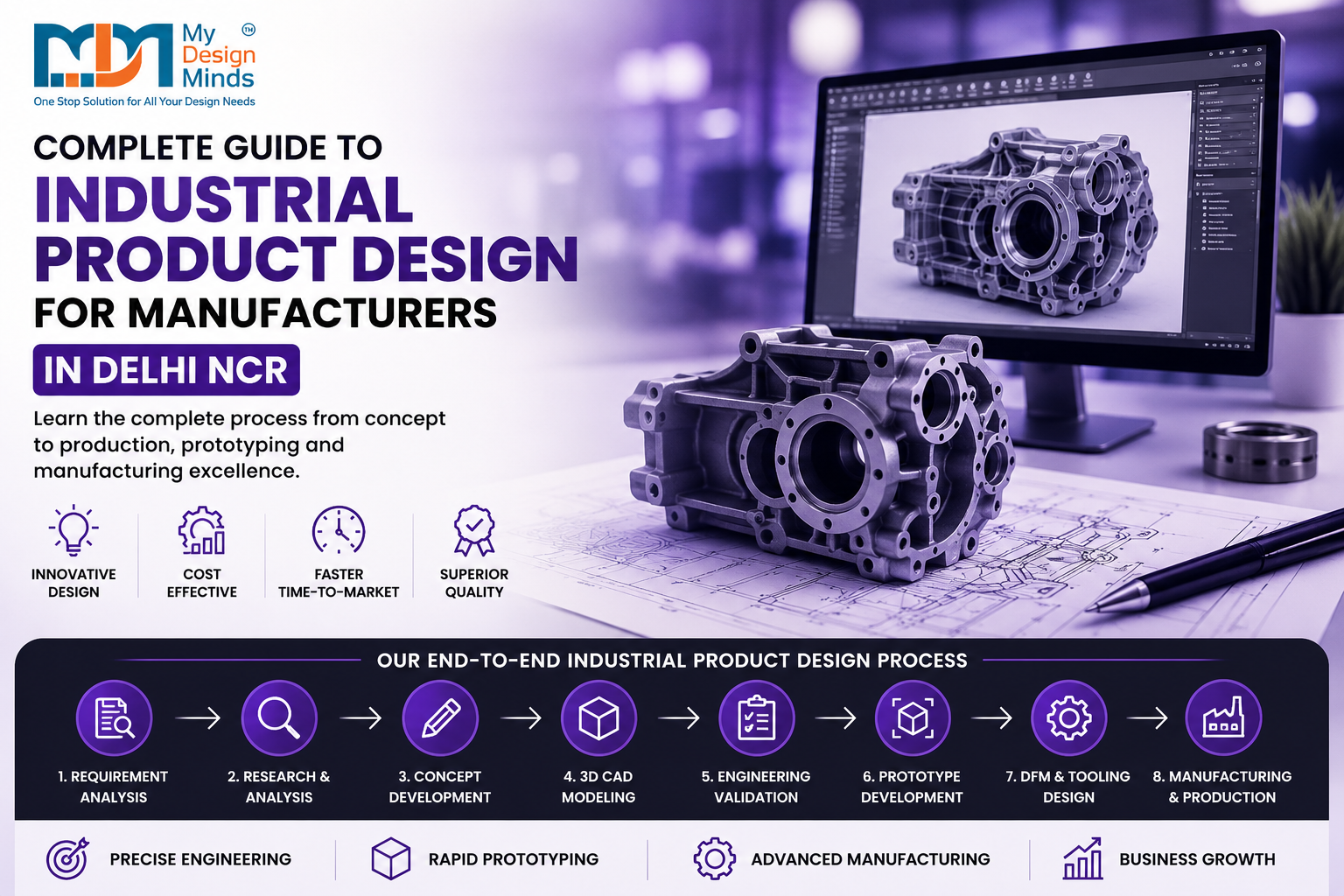
Complete Industrial Product Design Process
1. Requirement Analysis
Every successful project starts by understanding:
- Product purpose
- Target users
- Industry standards
- Market requirements
- Functional specifications
- Budget
- Manufacturing volume
This stage ensures the product meets both customer and business goals.
2. Research & Competitive Analysis
Design teams study:
- Existing market products
- User pain points
- Material options
- Manufacturing technologies
- Design trends
- Patent considerations
Research minimizes development risks while identifying opportunities for innovation.
3. Concept Development
Designers create multiple concepts using:
- Hand sketches
- Digital illustrations
- Product renderings
- Functional layouts
The best concept is selected after evaluating manufacturability, functionality, aesthetics, and cost.
4. 3D CAD Modeling
The approved concept is converted into precise 3D CAD models using professional engineering software.
This stage includes:
- Part modeling
- Assembly design
- Motion studies
- Structural planning
- Component integration
Accurate CAD models become the foundation for manufacturing.
5. Engineering Validation
Engineers verify:
- Strength
- Durability
- Assembly feasibility
- Material selection
- Weight optimization
- Manufacturing limitations
Simulation tools help detect design issues before physical prototypes are produced.
6. Prototype Development
Rapid prototyping validates the design before investing in tooling.
Common prototype technologies include:
- SLA 3D Printing
- SLS Printing
- FDM Printing
- CNC Machining
- Vacuum Casting
Prototypes help evaluate functionality, ergonomics, and fit before mass production.
7. Design for Manufacturing (DFM)
Design for Manufacturing (DFM) ensures the product is optimized for efficient manufacturing by simplifying geometry, selecting suitable materials, managing tolerances, and reducing unnecessary complexity. Applying Design for Manufacturing (DFM) early helps lower production costs and improve quality.
Key considerations include:
- Material optimization
- Wall thickness
- Draft angles
- Tool accessibility
- Assembly simplification
- Cost reduction
This stage significantly reduces manufacturing risks.
8. Tooling Design
Depending on production requirements, tooling may include:
- Injection moulds
- Pressure die casting dies
- Blow moulds
- Sheet metal dies
- Jigs & fixtures
Proper tooling design improves production accuracy and extends tool life.
9. Pilot Production
Before mass production:
- Sample parts are manufactured
- Quality inspections are performed
- Functional testing is completed
- Customer approval is obtained
Any remaining issues are corrected before full-scale manufacturing.
10. Mass Production Support
Industrial Product Design in Delhi NCR teams continue supporting manufacturers by:
- Improving production efficiency
- Resolving manufacturing issues
- Updating CAD files
- Managing engineering changes
- Supporting quality improvements
Industries That Benefit
Industrial product design is valuable for:
- Automotive
- Consumer electronics
- Medical devices
- Industrial machinery
- Home appliances
- Aerospace
- Agriculture equipment
- Packaging products
- Electrical products
- Smart devices
Why Manufacturers Choose Delhi NCR
Delhi NCR has become one of India’s strongest engineering ecosystems due to:
- Skilled product designers
- Experienced mechanical engineers
- Advanced CAD expertise
- Rapid prototyping facilities
- Tooling manufacturers
- CNC machining companies
- Injection mould manufacturers
- Strong supply chain
- Cost-effective engineering solutions
These capabilities allow manufacturers to complete the entire product development cycle within one region.
Common Mistakes to Avoid
Manufacturers often face delays because they:
- Skip prototype validation
- Ignore manufacturability
- Choose incorrect materials
- Overcomplicate designs
- Delay engineering reviews
- Overlook assembly requirements
Addressing these issues early saves time and cost.
Choosing the Right Industrial Product Design Partner
Look for a company that offers:
- Industrial Design
- Product Engineering
- CAD Design
- Reverse Engineering
- Prototyping
- DFM Analysis
- Tool Design
- Manufacturing Support
- Quality Assurance
- End-to-end product development
A complete-service partner reduces coordination challenges and accelerates product development.
Future of Industrial Product Design
Modern manufacturing is increasingly adopting:
- AI-assisted design
- Digital twins
- Additive manufacturing
- Smart materials
- Sustainable product design
- Simulation-driven engineering
- IoT-enabled products
Manufacturers embracing these technologies can improve innovation, reduce costs, and respond more quickly to market demands.
Conclusion
Industrial Product Design in Delhi NCR is no longer just about creating attractive products – it is about building solutions that are innovative, functional, manufacturable, and commercially successful. For manufacturers in Delhi NCR, investing in professional industrial product design leads to faster product development, reduced production costs, improved quality, and stronger market competitiveness.
Whether you are launching a new product or improving an existing one, partnering with an experienced product design company like My Design Minds can help you transform ideas into high-quality products through industrial design, engineering, prototyping, tooling, and manufacturing support.
